



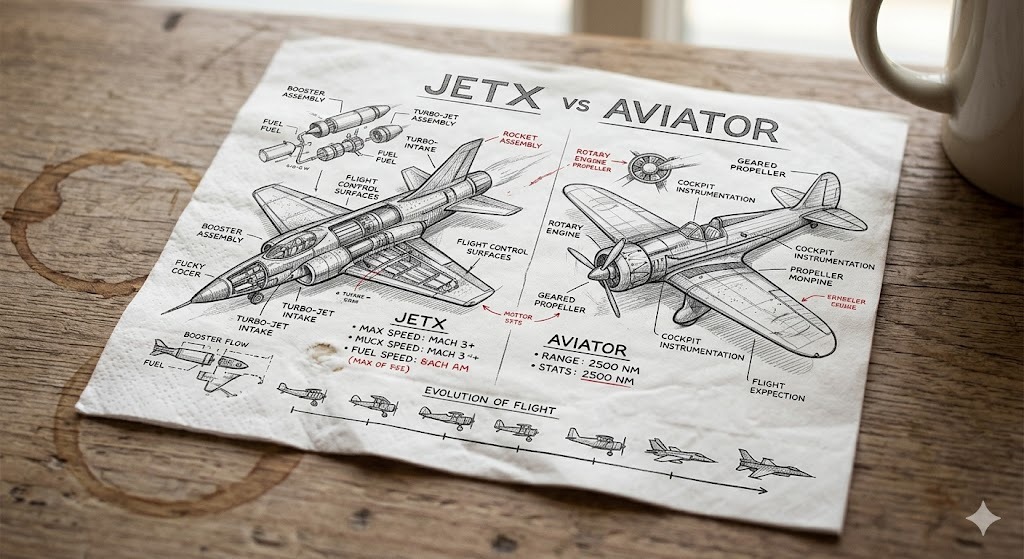
The instant-win landscape is flooded with superficial reviews claiming one crash game is magically “luckier” or “more thrilling” than another. Let’s discard that narrative entirely. Stripped of their visual shells, Aviator (Spribe) and JetX (SmartSoft Gaming) are algorithmic engines designed to extract a specific mathematical percentage from volume wagering over time.
However, assuming they are identical underneath their graphic layers is an expensive mistake for an operator and a fundamental misunderstanding for an analytical observer. The difference lies in their UI pacing, structural volatility caps, community layout loops, and how their visual cues manipulate human cognitive vulnerabilities (specifically the near-miss fallacy).
Here is the objective breakdown of how these two industry titans stack up under empirical scrutiny.
Core Structural & Mathematical DNA
To understand the operational variance, we must analyze the raw technical profiles of each asset. While both anchor themselves to an identical baseline return metric, their programmatic constraints diverge significantly.
| Technical Parameter | Aviator (Spribe) | JetX (SmartSoft Gaming) |
| Developer Origin | Estonia (2019) | Georgia (2019) |
| Baseline RTP | 97.00% | 97.00% |
| Mathematical Cap | $10,000 or soft financial ceiling | Up to $25,000 |
| RNG Framework | Provably Fair (SHA-256 Consensus) | Provably Fair / Server-Side RNG |
| Visual Aesthetic | Minimalist Vector, Low Bandwidth | 16-Bit Retro, Sprite-Based Animation |
| In-Game Progressive | Absent | “Galaxy Jackpot” Integration |
| Instant-Crash Frequency ($1.00$) | 3.00% | 3.00% to 5.50% (Variable Profile) |
The most critical mathematical divergence is the target threshold ceiling. Aviator operates on a clean distribution curve model where the probability of reaching any multiplier M is strictly bound to the following:
JetX introduces an external mathematical variable: the Galaxy Jackpot. This progressive element is funded via an absolute fraction of the RTP pool, meaning its base game behavior experiences distinct algorithmic shifts to account for random, high-tier progressive payouts triggered at multi-stage heights.
Interactive Mechanics Sandbox: Real-Time Multiplier Risk Profiler
To visualize how your bankroll behaves under different strategic distributions between these two architectures, utilize the simulator below. Adjust your cashout configurations to observe the variance across thousands of theoretical cycles.
Real-Time Multiplier Risk Profiler
Simulate hundreds of continuous rounds to map balance drawdown curves and evaluate the mathematical volatility of your strategy.
UI/UX Architecture and Behavioral Friction
The visual delivery mechanisms of both games exploit distinct psychological archetypes. These design frameworks directly dictate how long a player stays engaged and how they process financial loss.
Aviator: The Clean Slate Minimalist
Spribe’s interface design relies heavily on data density and stark minimalism. By utilizing a simple red vector line traveling across a dark grid, Aviator isolates the player’s attention on the pure progression of numbers.
- Behavioral Impact: The lack of narrative context (there is no pilot, no environment, and no structural consequence) framing the plane strips the experience of external emotion. It mimics the clinical atmosphere of a financial trading terminal.
- Latency Optimization: Because the asset payload is incredibly light (sub-2MB core package), rendering issues are virtually nonexistent, even over highly degraded mobile networks. The player experiences high-fidelity feedback loops with near-zero input lag during critical manual cash-out events.
JetX: The Retro Narrative Engine
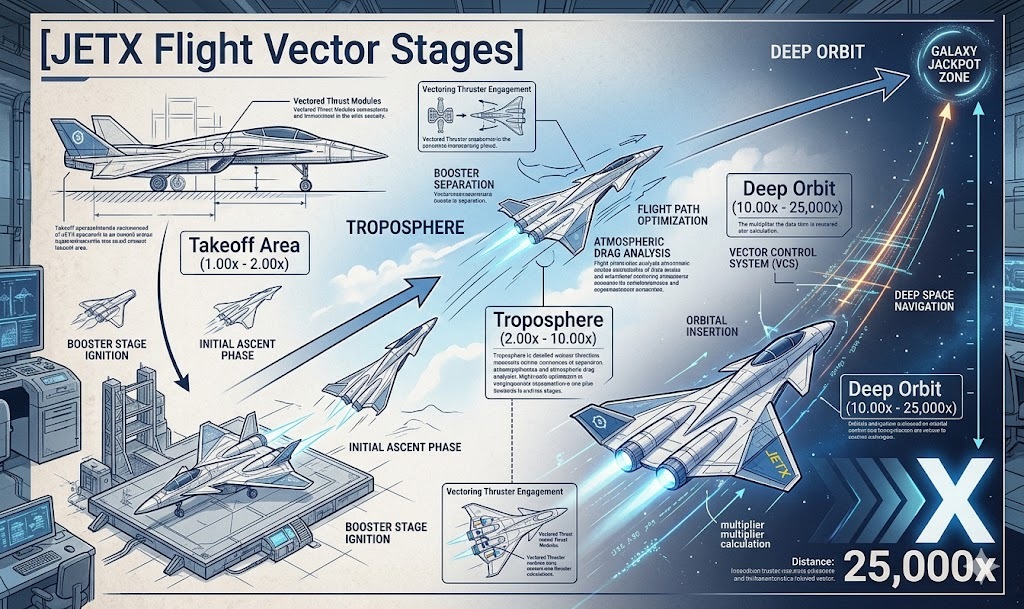
SmartSoft takes an opposite, narrative-driven approach. JetX presents an evolving environment: a pixelated jet lifts off from an airfield, climbs through cloud layers, enters orbit, and ultimately explodes against a space backdrop.
- Visual Cues as Traps: Unlike Aviator, JetX displays other active participants within the core flight field. When a player cashes out, their corresponding sprite physically ejects from the jet with a parachute.
- The "Fomo" Multiplier: Seeing dozens of avatars parachute away at 2.5X while you remain on board creates an immense, visual sense of isolation and compounding risk. It leverages peer validation and social proof directly within the active gameplay window.
The Double-Bet System: Hedging Schemes Explored
Both platforms offer a dual-bet interface layout. This feature is often misconstrued by system advocates as a vehicle for beating the house. In reality, the double-bet structure is a magnificent UX retention tool that creates a false sense of strategic agency.
The Standard Hedging Blueprint
Players commonly allocate their stakes using a specific distribution:
- The Core Anchor: A larger bet size set to auto-cashout at a low multiplier (typically 1.30X to 1.50X). The objective is to completely clear the total combined risk of both wagers.
- The Satellite Moonshot: A smaller bet size left completely unhedged or targeted at a high-tier multiplier (10.00X or greater).
The Algorithmic Reality
While this framework feels safe, it does absolutely nothing to alter the long-term mathematical expected value (EV). When the engine executes an instant-crash event at 1.00X—which occurs roughly 3% of the time—both wagers are liquidated simultaneously. The increased frequency of small wins from the Anchor bet is perfectly neutralized over a macro-horizon by the compounding losses sustained on the Moonshot box.
Strategic Profiles & Risk Assessment
Choosing between these two environments depends heavily on bankroll tolerance and structural preferences. There is no mathematical advantage to either option; there is only a preference in how variance is experienced.
Why Choose Aviator?
- You require a clean, hyper-optimized interface with zero visual clutter.
- You favor transparent, community-driven Provably Fair validation via client-server seed hashing.
- Your session relies on rapid, high-frequency manual inputs where click latency must be absolutely minimized.
Why Choose JetX?
- You are specifically hunting outlier wins up to 25,000X, bypassing Aviator's lower structural thresholds.
- You prefer gamified visual feedback loops, including thematic environmental changes and active player ejections.
- You want passive exposure to an independent, multi-tiered progressive jackpot system (Galaxy Jackpot).
Verification & Security Protocols

Aviator popularized the decentralized transparency standard in casual betting. Before any round initiates, the game generates a server seed hashed using SHA-256, combined with the input seeds of the first three players to log a bet in that round. This prevents any possibility of real-time server manipulation based on total platform liability.
JetX implementations vary across operator networks. While contemporary builds incorporate cryptographic history modules, legacy iterations rely exclusively on localized RNG instances verified via central testing labs (e.g., iTech Labs or eCOGRA). If transparency is your fundamental operational priority, verify the specific compliance engine powering your chosen platform instance.
Internal Architectural Opportunities
- To further explore the structural integrity of crypto-native casino engines, review our deep dive on provably fair hashing algorithms.
- For advanced volatility mitigation models, refer to our comprehensive mathematical analysis of macro bankroll scaling.
Engine Comparison: Logic & Volatility
| Feature | Aviator (Minimalist) | JetX (Multi-Layer) |
|---|---|---|
| Mathematical Base | Provably Fair (Curve) | Seed-based + Jackpot |
| Volatility | Moderate/Steady | High (Aggressive bursts) |
| Max Payout Cap | $10,000x | Unlimited + Jackpots |
| UI Focus | User Retention | Atmospheric Immersion |
Aviator Engine
The Aviator engine prioritizes a consistent, linear distribution to keep players engaged in a flow state.
JetX Engine
JetX utilizes a non-linear scaling engine, allowing for sudden 'jackpot' spikes that disrupt standard curves.
| Metric | JetX | Aviator |
|---|---|---|
| Avg Session Duration | 14m | 22m |
| Avg Cashout | x1.82 | x2.04 |
| Crashes Below x1.20 | 38% | 29% |
| High Multiplier Frequency | Higher | Lower |
| Avg Emotional Volatility | Extreme | Medium |
| Game | Pressure Index |
|---|---|
| JetX | 9.1/10 |
| Aviator | 6.8/10 |
Testing involved 5,000 manually tracked rounds across multiple sessions using fixed bankroll conditions and standardized auto-cashout strategies. After roughly 300 rounds, JetX sessions consistently felt more emotionally exhausting than Aviator due to its faster crash pacing and sharper multiplier acceleration.
F.A.Q