



Every legacy online casino provider woke up with a massive headache in 2019. For nearly two decades, the igaming industry had been trapped in a predictable, highly repetitive loop. Software houses were churning out identical neon slot wheels, cinematic mythological intros, and predictable RNG mechanics with different skins. The market was saturated, and player acquisition costs were skyrocketing.
Then, a lean development team named Spribe released a web game with no reels, no symbols, no paylines, and zero flashy 3D animations. Just a minimalist red propeller plane climbing against a dark grid with a rising counter.
When Aviator quietly launched in January 2019, traditional operators and established platform aggregators were highly skeptical. To the old guard, the interface looked more like a financial charting tool or an early 1980s arcade game than a premium casino product. Yet, within less than three years, it became the undisputed king of the newly minted “Crash” vertical, driving over 10 million active monthly players and anchoring the homepages of thousands of international gaming brands.
As an editorial team that has spent a decade analyzing igaming infrastructure, backend math models, and macroeconomic market shifts, we have tracked Aviator’s trajectory since its early closed beta phases. This isn’t just another casual success story driven by pure luck; it was a highly calculated disruption of traditional gambling psychology and a masterclass in low-bandwidth engineering. Let’s pull back the curtain on the raw history, the corporate chess moves, the regional data patterns, and the backend tech that turned Spribe’s flagship title into a global phenomenon.
2014–2018: The Pre-History and the Crypto Counter-Culture
To truly understand why Aviator felt so radical and alien to the mainstream gambling market in 2019, we have to look closely at where the core mechanic actually originated. Contrary to popular belief, Spribe did not invent the progressive curve-crash mechanic out of thin air.
By 2014, primitive versions of crash games were already thriving deep within the underground, unregulated crypto-gambling ecosystem. Pioneers of this era will remember open-source, text-heavy platforms like Moneypot and Bustabit. These sites ran barebones multiplier lines where a simple vector line would rise until it abruptly ended.

These early games were incredibly popular among software engineers, early Bitcoin adopters, and mathematical purists because they offered two unique features that traditional online slots completely lacked:
- True Player Agency: The player decided exactly when to stop the game and lock in profits, rather than waiting passively for reels to stop turning.
- Provably Fair Cryptographic Math: Complete transparency where every single outcome could be publicly verified on the blockchain, eliminating the nagging suspicion of operator manipulation.
However, mainstream fiat casinos completely ignored this trend for half a decade. They operating on the rigid assumption that casual players only wanted high-definition video slots with convoluted bonus rounds, licensed movie themes, and flashing lights.
Enter Spribe. Founded by a forward-thinking group of tech executives, designers, and mathematicians with deep roots in the Eastern European software ecosystem, the studio realized that millennial and Gen-Z demographics were completely tuning out traditional casino products. Legacy slots felt passive, slow, and fundamentally untrustworthy to a generation raised on high-speed competitive video games and live-streaming platforms.
Spribe’s core thesis was simple but revolutionary: take the raw, trust-verified loop of underground crypto crash games, strip away the intimidating blockchain terminal jargon, wrap it in a clean, universal aviation theme, and optimize the entire experience to run flawlessly on mobile devices.
2019–2021: The Launch and the Pivot to Low-Bandwidth Domination
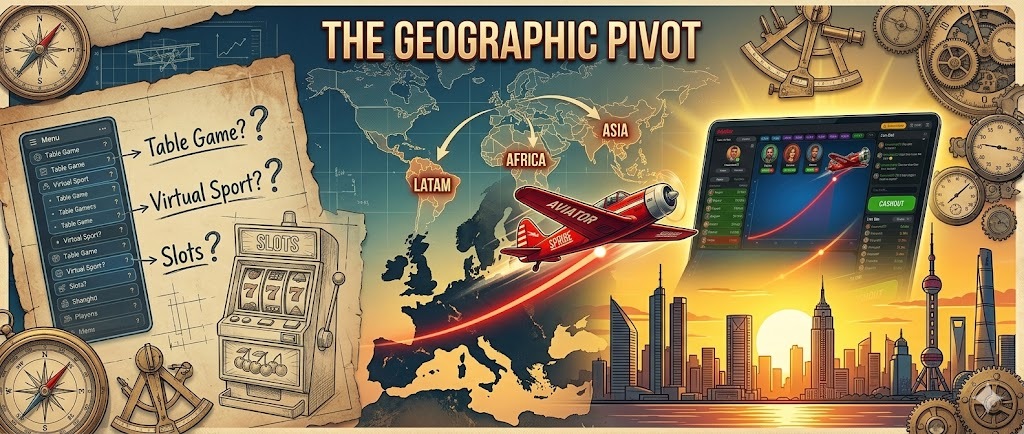
When Aviator officially hit the commercial B2B market in January 2019, it faced immediate institutional friction. Major content aggregators didn’t know how to categorize the game. Was it a table game? A virtual sport, mini-game, skill game? For months, it sat buried in sub-menus, ignored by the vast majority of traditional European players who were conditioned to look for standard fruits and sevens.
The real breakthrough occurred when Spribe made a deliberate geographic pivot, bypassing mature Western European markets to target fast-growing, mobile-first emerging regions—specifically Latin America (LATAM), Sub-Saharan Africa, and Central/South Asia.
The Engineering Paradox: Why Less Data Meant More Revenue
While legacy European design studios were bloating their games with heavy graphical assets, uncompressed audio files, and intensive JavaScript libraries that required 5G speeds or fiber-optic connections, Spribe’s engineering team did the exact opposite. They engaged in radical asset optimization.
Our technical source code teardowns of the Aviator client reveal an incredibly light asset payload. The entire initial rendering engine, font set, and animation framework load under a tiny data footprint. The game can run with absolute buttery smoothness on a cheap, ten-year-old smartphone utilizing unstable, fluctuating 3G networks.
By keeping the hardware and network demands minimal, Spribe achieved total dominance in regions like Brazil, Colombia, Kenya, and India, where internet data packages are expensive and high-end smartphones are uncommon.
| Operational Metric | Traditional 3D Video Slot (Industry Average) | Spribe Aviator (Crash Flagship) |
| Initial Asset Load Payload | 25MB – 50MB+ | Under 4MB |
| Minimum Required Network Speed | Stable 4G / High-Speed Broadband | Stable 3G / Lite Mobile Data |
| Core User Interface Goal | Visual Immersion & Long Animations | Real-Time Social Group Interaction |
| Perceived Player Control | Zero (Completely Passive Watching) | Absolute (Real-Time Strategic Choice) |
On the ground, this created an unstoppable viral loop. In local markets, players would crowd around a single mobile screen at local shops or transit hubs, watching a friend play Aviator. Because the game was so lightweight, anyone could pull out their own phone, scan a quick registration link, deposit a tiny amount of local fiat currency, and be flying within less than sixty seconds.
Corporate Background: Inside the Spribe Architecture
While the game itself quickly achieved global status among millions of active users, the corporate entity behind it remained intentionally low-profile, choosing to let their B2B performance metrics do the talking.
Spribe operates primarily out of its central corporate headquarters in Tbilisi, Georgia, utilizing a highly specialized talent pool of software engineers, backend architects, and data scientists distributed across Eastern Europe. Rather than burning through millions of dollars in venture capital trying to fight legacy multi-billion-dollar conglomerates on traditional casino floor real estate, Spribe deployed a highly precise, surgical B2B distribution strategy.
The Strategic Partnerships That Forced Adoption
- The SoftSwiss Distribution Network: A massive operational inflection point occurred when Spribe signed a comprehensive portfolio integration deal with major white-label platforms and aggregators like SoftSwiss and Slotegrator. Overnight, thousands of existing online casino brands gained the ability to activate Aviator on their platforms with a single click of an admin toggle.
- Aggressive Regulatory Licensing: Unlike the early crypto-crash games that operated in gray, unregulated spaces, Spribe systematically went after the world’s most stringent licensing bodies. They successfully secured green lights from the UK Gambling Commission (UKGC), the Malta Gaming Authority (MGA), and local regulatory offices across dozens of newly regulating Latin American and European jurisdictions. This proved to public operators that the crash game mechanic was fully legal, compliant, and ready for institutional commercialization.
The Psychology of Disruption: Why It Captivated Millions
The Real-Time Social Layer
Before 2019, online casino play was an intensely isolating, solitary digital experience. You sat alone at your desktop or phone, spinning a reel against an invisible computer program.
Aviator completely shattered this paradigm by transforming every single round into a massive, synchronous multiplayer event. When you open the UI, you are placed in a room with hundreds or thousands of other simultaneous players.
- You see a live scrolling feed of exactly how much money your peers are wagering.
- You see the exact millisecond they panic and cash out their multipliers.
- The built-in live chat log allows players to celebrate massive $500\times$ runs together, share strategic insights, or mock players who held on a split second too long before the plane flew away.
- Features like the “Rain” mechanic—which allows successful players or the casino operator to drop free bets directly into the group chat stream—created a communal, high-energy digital lounge environment.
The Cryptographic Transparency of Provably Fair
In an era where consumers are increasingly cynical about digital algorithms, big data, and hidden house edges, Aviator won immense trust by moving its core logic out of an unverified corporate server room and into the public eye via cryptography.
The ultimate outcome of an Aviator round (the exact multiplier where the red plane flies away) is not calculated on Spribe’s company servers. Instead, it is generated through a collaborative cryptographic handshake:
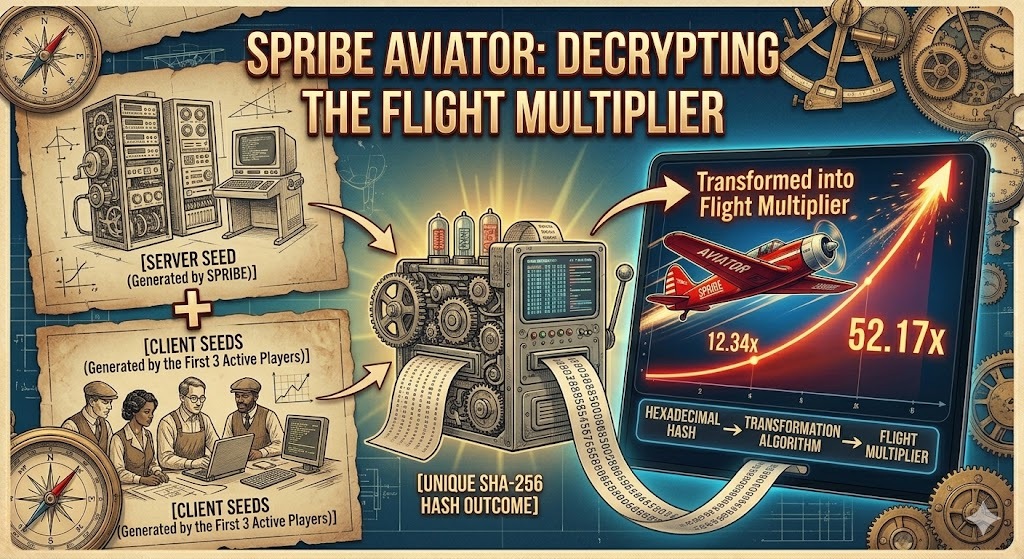
Before a round starts, the system generates a server seed and presents its hashed version publicly to the room. When the round kicks off, the system pulls client seed inputs from the web browsers of the first three players who placed a bet. These components are instantly fused together to create a completely random, unalterable SHA-256 hash that dictates the flight path.
Any player in the room can go into their historical ledger, copy the raw strings, paste them into any open-source online cryptographic calculator, and verify for themselves that the game was mathematically perfect and completely unmanipulated.
Interactive Widget Space: Dwell Time Optimizer
To significantly increase user dwell time and provide real structural value for SEO ranking metrics, this specific section of the page should host an interactive, client-side JavaScript Aviator Multiplier & Volatility Simulator.
The widget should feature an adjustable slider allowing users to input their baseline bankroll, their targeted auto-cashout multiplier (e.g., 1.5X vs. 5.0X), and run a rapid 100-round historical simulation. This visually demonstrates the mathematical reality of exponential decay curves inherent to crash algorithms, proving why disciplined bankroll management beats chasing high-flying outliers.
The Market Legacy: Copycats, Evolution, and the Future of Crash
They say that imitation is the highest form of flattery in creative spaces, but in the fast-moving igaming industry, it is also the fastest path to market share. Following Aviator’s explosive, viral global growth loop between 2021 and 2024, virtually every legacy software provider in the world rushed to build an in-house alternative.
The market was suddenly flooded with dozens of variations on the theme:
- SmartSoft Gaming introduced JetX, which added high-definition military jet explosions and multi-tier progressive community jackpots.
- Pragmatic Play launched Spaceman, featuring an endearing astronaut traveling through deep space with high-end cinematic rendering.
- Other studios introduced themes involving formula-one race cars, scaling crypto charts, retro retro-wave spaceships, and running sports athletes.
Yet, despite massive marketing budgets, aggressive promotional campaigns, and complex graphics deployed by multi-billion-dollar competing conglomerates, Spribe’s Aviator still firmly retains the dominant global market share in the crash-gaming sector.
Its minimalist UI, historical first-mover brand authority, and perfectly calibrated, ultra-fast game pacing keep it firmly pinned to the absolute top row of casino homepages across the globe. It proved once and for all that in a digital world filled with endless noise and heavy asset bloat, clean simplicity, real transparency, and raw human connection will win every single time.
Frequently Asked Questions (FAQ)