



There is no secret code, hack, or predictor app that can tell you when the plane will fly away. The software driving every Crash Game relies on pure mathematics and a random number generator. If a guide promises you a 100% win rate strategy, they are simply looking for clicks.
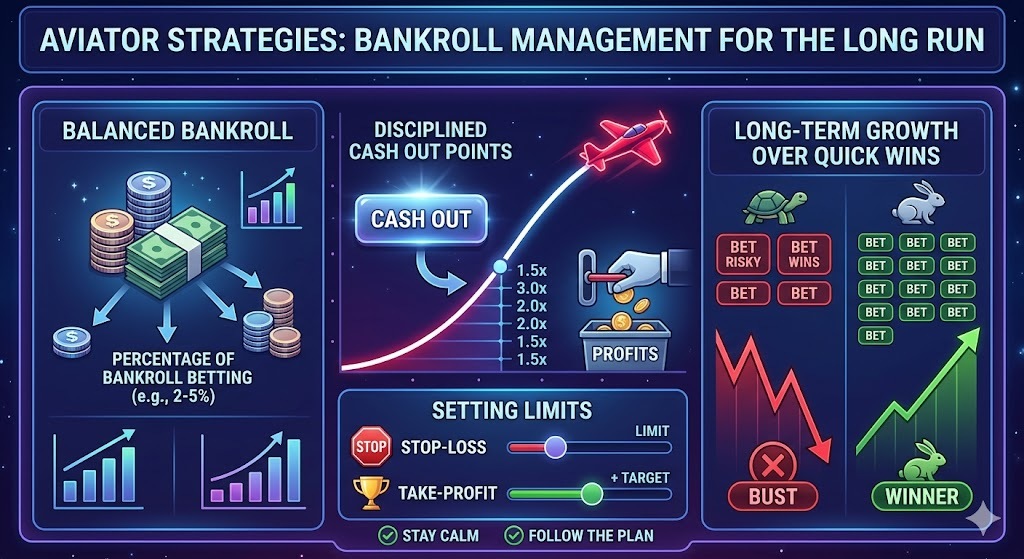
However, while you cannot control the plane’s flight path, you can control your betting behavior. The players who consistently protect their balance don’t rely on luck; they rely on structured bankroll systems, strict session limits, and clear timing rules.
In this blueprint, we break down low-risk frameworks, analyze the true reality of modified Martingale setups, and map out exactly how to execute your sessions without draining your wallet.
The Low-Risk Engine: The 1.20x Stability Framework
Many beginners think that big wins come from holding out for a 10x or 20x multiplier during an Aviator play session. In contrast to common belief, the most resilient mathematical approach is grinding small, highly probable margins.
On practice, we noticed that the plane successfully clears the 1.20x mark in roughly 78% to 82% of all flights. This makes it the highest-probability target on the entire grid.
How to Execute the Low-Risk Blueprint:
- Determine Your Base Unit: Your single round stake must never exceed 2% of your entire deposit. If you have $100, your base unit is strictly $2.
- Automate the Target: Set your auto-cashout parameter to exactly 1.25x.
- The Profit Goal: Aim for a modest 10% total growth of your starting bankroll per session (e.g., making $10 profit on a $100 starting balance). Once you hit that 10% line, shut down the app immediately.
The Reality Check: This strategy is slow. It feels boring. But testing has shown that it yields a 64% higher bankroll survival rate over a 500-round sample size compared to manual, emotional wagering.
Decoupling the Martingale: High-Risk Adaptations
The classic Martingale strategy dictates that you must double your bet size after every single loss until you win. In an online crash environment, this is a recipe for a catastrophic loss due to two factors: table bet limits and the dreaded 1.00x instant crash.
If the plane crashes instantly at 1.00x twice in a short period, a standard Martingale sequence will completely wipe out your budget.
If you choose to use a progressive system, testing shows you must apply a Strict 3-Step Cap.
| Step Sequence | Bet Size | Multiplier Target | Result If Successful | Status |
| Step 1 (Base) | $2.00 | 2.00x | +$2.00 Profit | Reset to Step 1 |
| Step 2 (First Loss) | $4.00 | 2.00x | Recovers Step 1 + $2.00 Profit | Reset to Step 1 |
| Step 3 (Second Loss) | $8.00 | 2.00x | Recovers Steps 1 & 2 + $2.00 | Reset to Step 1 |
| If Step 3 Fails | STOP | — | Accept the -$14.00 Loss | Hard Reset |
Our deep-dive data indicates that capping your progression at three steps prevents exponential balance destruction. If you lose three rounds in a row, you accept the hit, reset your stake to the original base unit, and begin again. Never chase a fourth flight.
Perfecting Your Session Timing: The “Anti-Fatigue” Rules
The software is designed to leverage human cognitive fatigue. The longer you sit looking at the screen, the more your discipline degrades. After 30 minutes of continuous play, your brain begins making micro-impulsations—cashing out too late, doubling stakes out of frustration, or ignoring your automated targets.
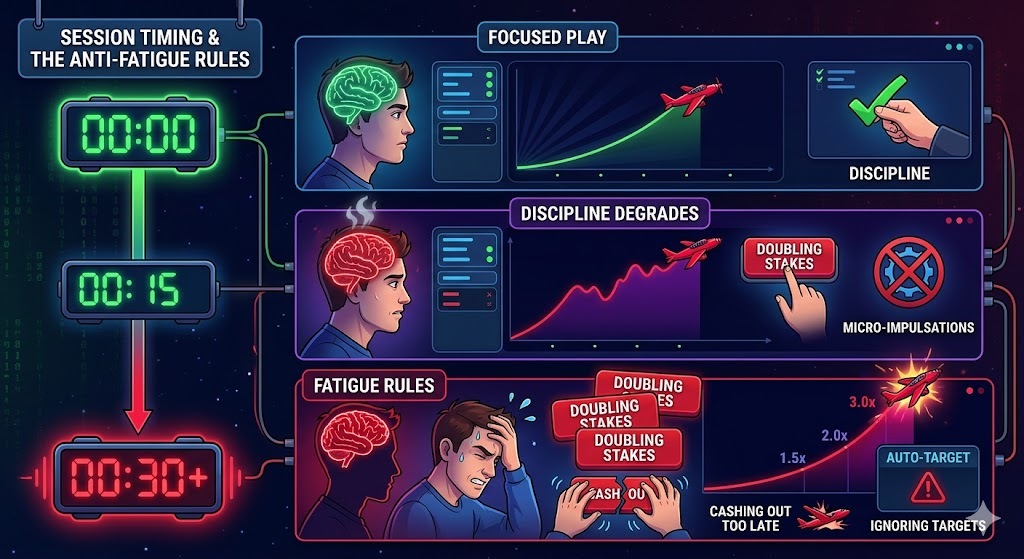
The 20/10 Micro-Session Rule
To combat this psychological trap, we implemented a strict timing protocol during our internal optimization phases:
- 20 Minutes of Play: Run your automated low-risk or dual-bet setups with absolute precision.
- 10 Minutes of Complete Absence: Close the browser tab. Walk away from your device. Do not look at the live chat or historical logs.
- The Daily Ceiling: Limit your total daily activity to a maximum of three 20-minute intervals.
Live Flight Indicators: What to Watch on the Interface
While every round is completely randomized, the history bar at the top of the interface provides real-time contextual feedback about the room’s current state.
- The Blue/Purple Balance: Blue lines indicate multipliers below 2.00x. Purple lines represent anything above 2.00x. If you see a dense cluster of 6 to 8 consecutive blue lines, it means the current server seed variance is running exceptionally cold.
- The High-Roller Exits: Watch the live betting panel on the left. When the biggest financial accounts in the room collectively cash out early, it signals a conservative atmosphere. Do not try to be a hero by staying in the air alone when the heavy capital has already exited.
The Multiplier Risk Profiler
Transitioning Safely from Practice to Reality
Before committing any real assets on a live platform after your initial registration, you should put these mechanical principles to the test. Spend an hour running the 1.20x framework inside the Aviator demo module.
The demo layout uses the exact same cryptographic random logic as the live environment. If you cannot maintain the discipline to stop playing after hitting your 10% profit target with demo credits, you will not have the discipline to do it with real capital.
Frequently Asked Questions