



Most players watch the red plane climb and assume they are playing against a standard, hidden casino server. They treat the game like a digital slot machine with flashy graphics. This assumption is a foundational mistake.
The mechanics driving every Aviator play session are completely transparent, rooted in public cryptography, and governed by a fixed mathematical framework. If you want to build a sustainable approach to this Crash Game, you must understand how the house edge operates and how the platform proves it isn’t manipulating your individual rounds.
What a 97% RTP Actually Means for Your Session
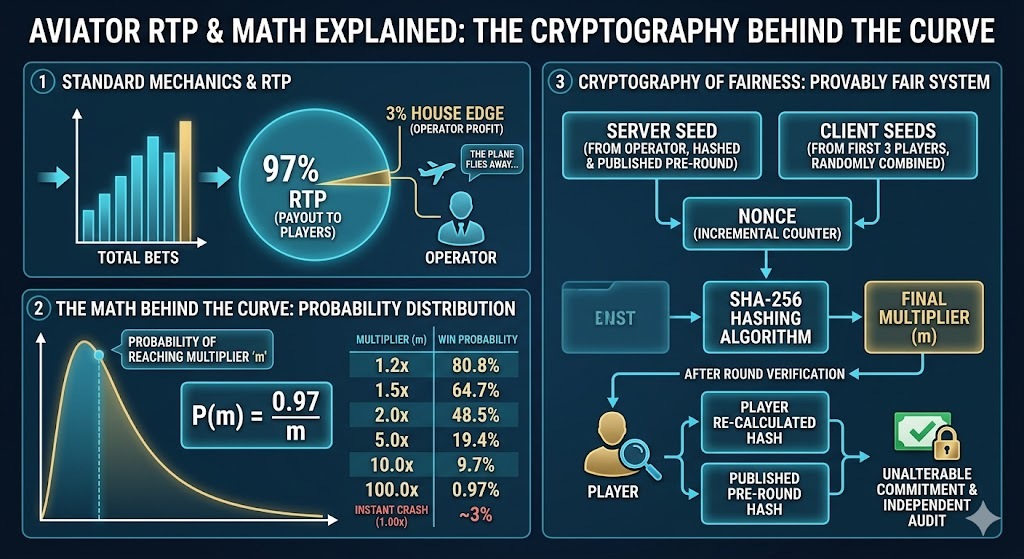
The game features a defined Return to Player (RTP) of 97%. In simple terms, this means that over millions of simulated rounds, the game engine mathematically retains 3% of all total wagers as the house edge, returning 97% back to the collective pool of players.
However, beginners frequently misunderstand how this percentage scales across short-term gameplay.
- The Macro Reality: The 97% benchmark is an average calculated over an infinite timeline. It does not mean you will get back $97 for every $100 you spend in a single evening.
- The Micro Reality: In a 20-round span, the actual payout variance can swing wildly between 10% and 500%. You are competing against short-term statistical spikes, not the lifetime average of the software.
The Math Behind the 3% House Edge
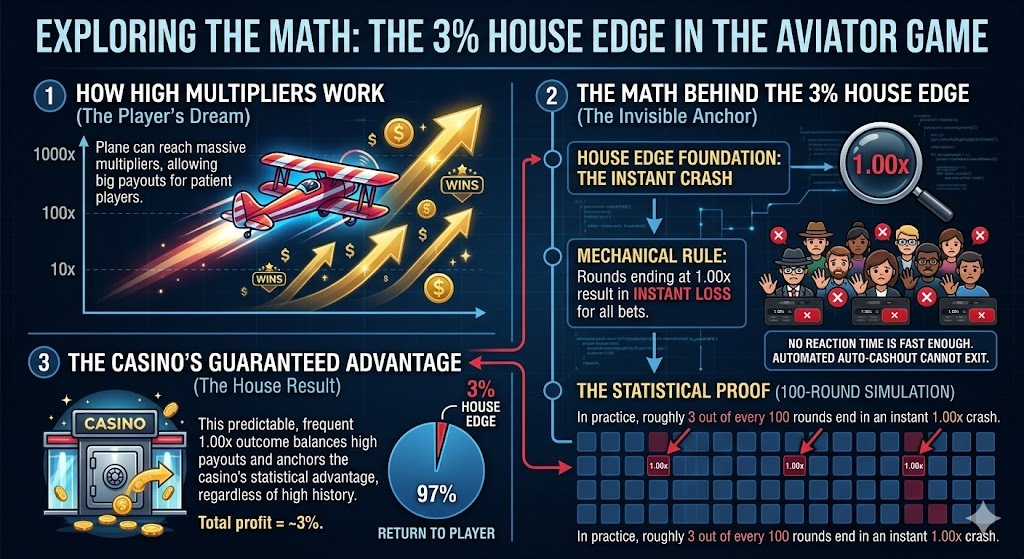
How does the game guarantee its 3% take if the plane can technically fly to a 100x or 1000x multiplier? The answer lies in the instant crash.
On practice, we noticed that roughly 3 out of every 100 rounds end at exactly 1.00x. When the plane crashes at 1.00x, every single active bet on the board loses instantly. No human reaction time or automated auto-cashout feature can exit at 1.00x. This single mechanical rule anchors the house edge, ensuring the casino maintains its statistical advantage regardless of how many high multipliers populate the history bar.
Demystifying Provably Fair Cryptographic Technology
Unlike traditional online slots that rely on closed-source Random Number Generators (RNG) hidden behind corporate servers, Aviator operates on a public Provably Fair algorithm. The outcome of each round is not generated solely by the casino. Instead, it is a collaborative cryptographic product of the server and the players themselves.
The Generation Process Step-by-Step
Before a round even begins, the game engine generates the final result using an open, verifiable formula. Here is how that data is constructed:
- The Server Seed: The platform generates a unique, randomized string of characters. This seed is securely hashed (encrypted) and displayed publicly before the round starts, ensuring the casino cannot alter it later.
- The Client Seeds: The game captures the client seeds from the first three players who place a bet for the upcoming round.
- The Merging Process: The system combines the Server Seed and the three Client Seeds into a single cryptographic string.
- The SHA-512 Hash Output: This combined string is processed through a SHA-512 encryption protocol, creating a long alphanumeric code. This code represents a specific mathematical value, which translates directly into the exact multiplier where the plane will fly away.
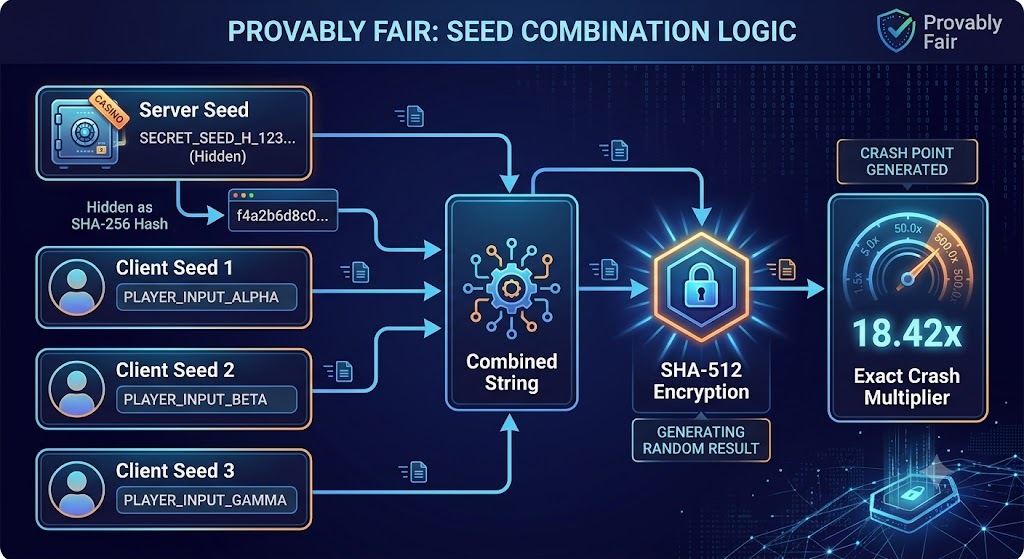
The Transparency Guarantee: Because your device contributes to the seed generation process, the platform cannot manipulate the plane’s flight path mid-flight to target high stakes. If they altered the outcome by even one millisecond, the final public hash would mismatch the initial server hash, exposing the manipulation instantly.
How to Manually Verify Any Round’s Fairness
You do not have to trust the platform’s word. The game features a built-in verification tool allowing you to audit the mathematical integrity of any past flight manually.
The Auditing Checklist:
- Click on the history icon at the top of the interface to display past multipliers.
- Select a completed round to view its specific Server Seed, Client Seeds, and the final combined SHA-512 hash.
- Copy these raw strings and paste them into any independent, public online SHA-512 calculator.
- If the calculator’s output matches the hash displayed in your game panel, the round was entirely fair and unmanipulated.
The Cryptographic Hash Verifier
Moving From Theory to Strategic Practice
Understanding the math changes how you interact with the interface after completing your initial platform registration. Since every hash outcome is independent, trying to find “patterns” or buying “prediction tools” is completely useless.
The most effective way to internalize this mathematical reality is by running consecutive rounds within the Aviator demo environment. Watch the history panel, track how often the 1.00x instant crash appears, and observe how the distribution of numbers conforms to the 97% RTP rule over time without risking actual capital.
Frequently Asked Questions