



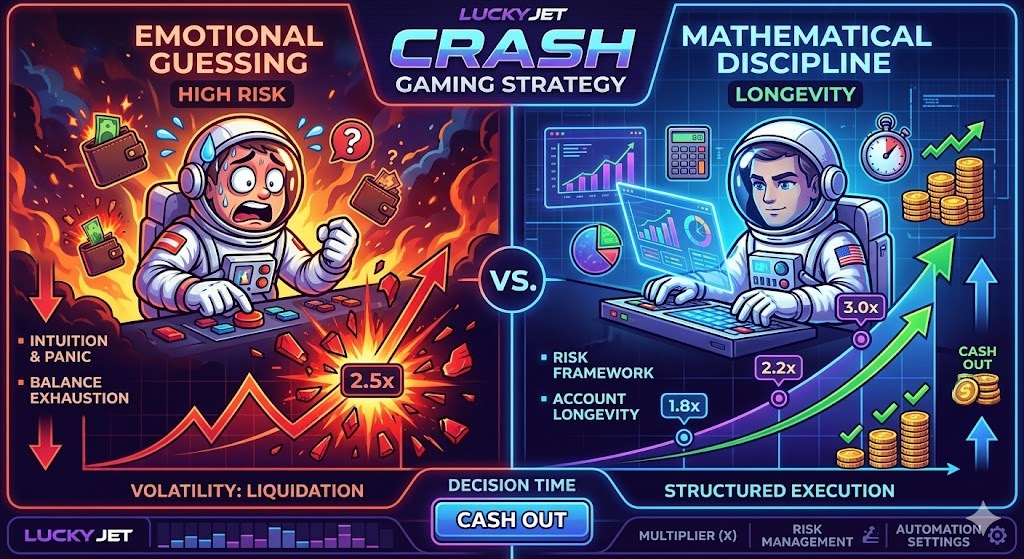
The rapid rise of the Crash Game genre across the iGaming sector is driven by its unique blend of extreme volatility and real-time player agency. Unlike traditional slots or table options where outcomes are passive, crash software forces you to make a high-stakes decision every single second: secure current returns or risk total liquidation for a higher multiplier.
However, because the underlying multiplier curve is governed by an automated cryptographic engine, relying on intuition or emotional reactions is an immediate path to balance exhaustion. To maintain longevity on the dashboard, you must replace emotional guessing with structured execution.
This deep dive breaks down the definitive risk frameworks, automation configurations, and mechanical traps you must master to navigate these high-velocity cycles.
The Core Pillar: High-Discipline Bankroll Management
Every successful session is built on a foundational rule: Never risk capital that cannot be entirely written off. In high-variance crash environments, your bankroll is not a collection of individual bets; it is a shield designed to absorb statistical variance.
The Fractional Unit Rule
To survive a prolonged sequence of early crashes, you must establish a strict Base Unit relative to your total deposit.
- Conservative Scaling: Your individual round wager should never exceed 1% to 2% of your total active balance. If your total wallet contains $200, your base position must be locked between $2.00 and $4.00.
- The Volatility Buffer: This fractional approach ensures your account can absorb a consecutive string of 10 to 15 low-multiplier rounds without triggering a catastrophic margin clearance.
- The Psychological Safe Zone: By keeping individual stakes small relative to the whole, you strip away the panic that leads to desperate, emotional decision-making.
Pro Tip for Finding the Best Returns: To maximize the efficiency of your bankroll management, you need to play on platforms that do not artificially lower game settings. The top licensed online casinos with verified, highest-tier RTP settings are thoroughly compiled and updated at Jetx.casino, giving you a clean mathematical starting point.
Architectural Automation: Utilizing Auto-Cashout Systems
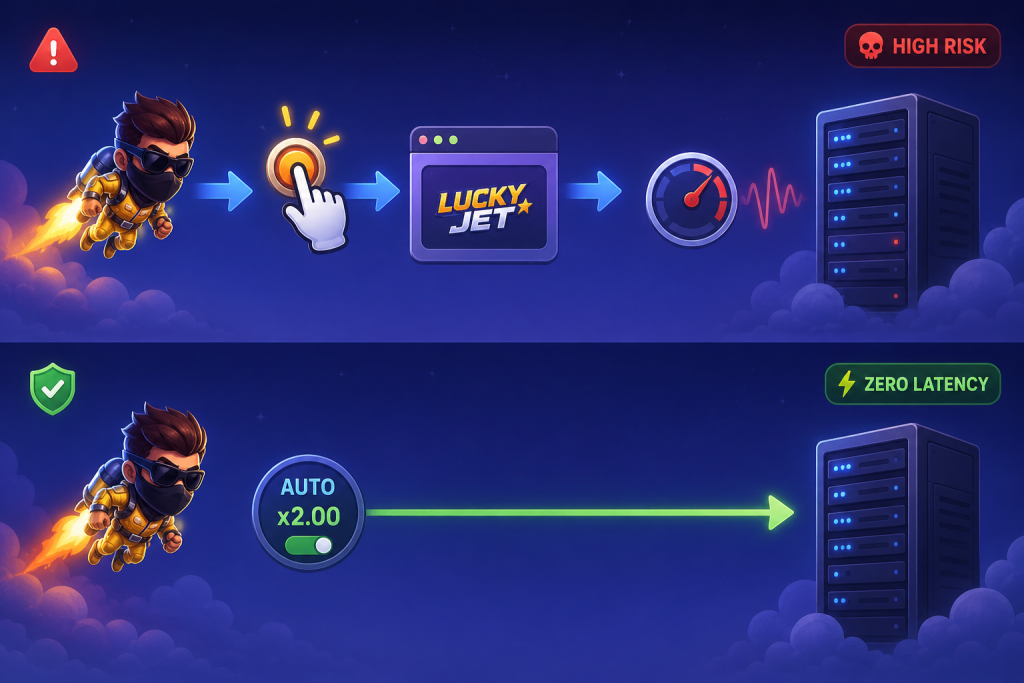
In a game where milliseconds dictate the boundary between a massive multiplier and an absolute zero, relying on manual human reflexes introduces unnecessary risk. Network latency, device stutter, and psychological hesitation can easily cost you a payout.
The Latency Shield
Configuring the Auto-Cashout input box forces the primary gaming server to execute your exit instruction natively. Because this script runs on the operator’s host side rather than inside your local web browser, your position is secured the exact microsecond the multiplier crosses your threshold—even if your local mobile connection drops or experiences a packet freeze.
Strategic Automation Layering
Advanced players deploy automated sub-routines using a multi-tiered approach:
- The Baseline Recouper: Setting a static auto-exit at 1.35x to 1.50x across consecutive rounds to build a highly repeatable cash flow foundation.
- The Automated Progression Cap: If using a manual scaling model, establishing an absolute automation ceiling at 5.00x to prevent greed from overriding a mathematically sound exit window.
Implementing Low-Risk Operational Approaches
While no configuration can bypass the inherent house edge, low-risk blueprints focus on minimizing volatility and maximizing your baseline win-rate probability.
The Fixed Conservative Exit Model
This framework relies entirely on high-probability targets. By focusing on the 1.10x to 1.25x multiplier corridor, you are trading massive payouts for high mathematical frequency. While the returns per round are small, these lower tiers hit with high consistency, allowing you to run steady volume.
Critical Caveat: An early instant crash (1.00x) requires many consecutive conservative wins to recover. Never over-leverage your stake size to compensate for the low yield.
The Staggered Dual-Bet Hedge
If the crash interface provides a dual-panel layout, split your entry into asymmetric roles:
- Primary Panel (The Anchor): 75% of the total stake, automated to trigger cashout at 1.33x. This yield covers the combined expenditure of both placements.
- Secondary Panel (The Runner): 25% of the total stake, left on manual or automated at a high-tier metric (e.g., 4.00x). This position is run completely subsidized by the primary panel’s success.
Expanding Your Strategy Across the Genre
While the core mechanics of risk remain uniform, every specific game title introduces unique UI paces, side-bet variations, or payout scaling rules.
If you are looking to master alternative variants, a complete library of specialized, audited crash game strategies for all of the industry’s most popular releases is available directly on Jetx.casino. Their strategic hubs cover optimized blueprints tailored specifically for:

- JetX & Aviator: Mastering high-volume multi-player flight dynamics and dual-panel tracking.
- Lucky Jet: Calibrating automated sub-routines around the rising volatility curve of Lucky Joe.
- Mines & Plinko: Navigating customized board risk profiles, row densities, and variable volatility grids.
- Spaceman: Implementing split-cashout strategies (50% collection mid-flight) unique to interstellar engine layouts.
Common Tactical Mistakes and How to Avoid Them
Analyzing aggregate session data reveals that balance liquidation rarely stems from a flaw in the software—it is almost always caused by a failure in player discipline.
The Martingale Trap (Exponential Ruin)
The most common mistake is doubling your wager after a loss to chase recovery. In a Crash Game, a cold streak can easily produce 8 to 10 consecutive rounds where the multiplier collapses below 1.20x. If you double your stake each time, an initial $1.00 wager accelerates to $256.00 by the ninth round, risking your entire bankroll for a microscopic original profit target.
Chasing the “Overdue” Multiplier
Many players look at the history log, see that a 100x multiplier hasn’t appeared in the last 60 rounds, and assume it is “due” to hit soon. This is a classic cognitive error known as the gambler’s fallacy. Every single round generates a completely isolated cryptographic seed sequence. The software has no memory; a high multiplier is no more likely to occur after 100 low rounds than it is after a high one.
Session Fatigue and “Tilt”
The fast-paced nature of crash loops triggers high dopamine spikes. After a major loss, emotional frustration (“tilt”) can cause you to break your own rules and place oversized bets. Professional players enforce an absolute hard limit: if you experience three consecutive sequence losses, close the application completely for at least two hours.

Mastering Crash Game Strategy