



Why This Mechanic Actually Changes Player Behavior
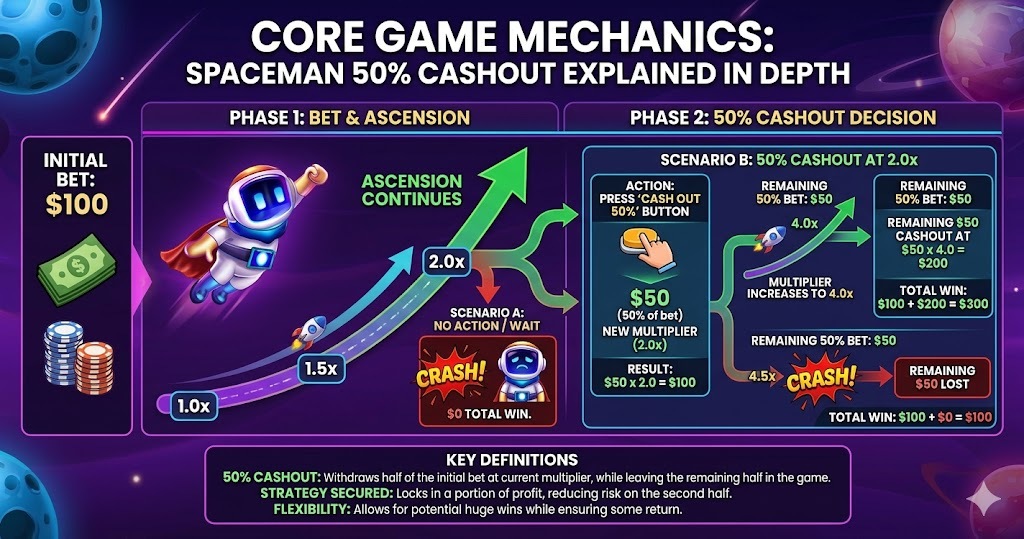
Most Crash Game systems are brutally simple. You either cash out everything or you lose everything. That binary structure is what creates tension, but it also creates chaos in decision-making.
Spaceman introduces something subtler: the 50% cashout feature, and at first it looks like a small quality-of-life option. In reality, it reshapes how players interpret risk, profit, and timing.
What’s interesting is not the mechanic itself, but what it does to the human brain under volatility. During repeated observation of Spaceman play sessions, we noticed that players who used partial cashout stopped behaving like “hope-based bettors” and started behaving more like “structured risk managers.” Their actions became less reactive. Less emotional. More deliberate.
That shift alone changes the entire experience of the game.
How the 50% Cashout System Actually Works
Mechanically, the system is simple. But simplicity is misleading here.
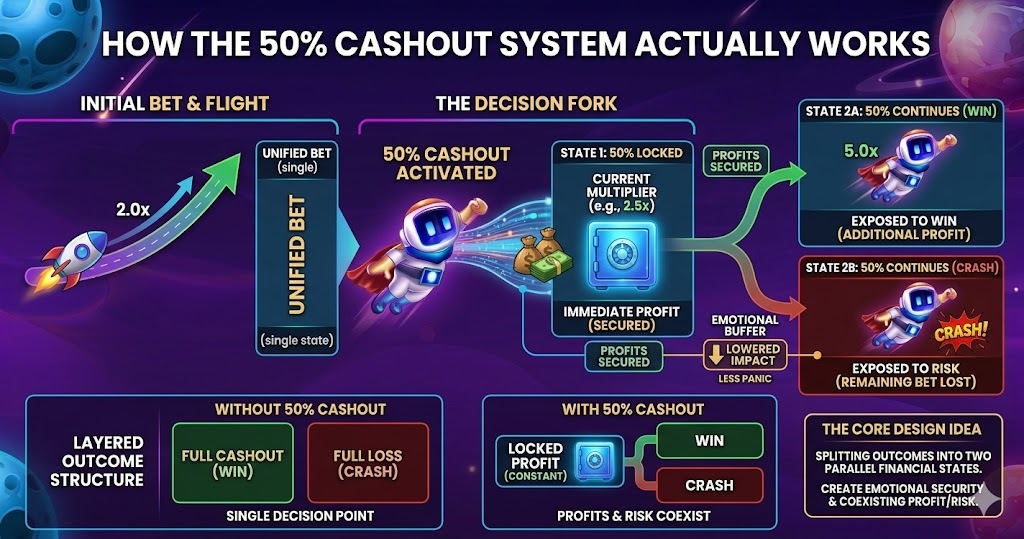
When you activate a 50% cashout, you are essentially splitting your outcome into two parallel financial states. One part is locked immediately at the current multiplier. The other remains exposed to the ongoing flight.
So instead of a single decision point — cash out or continue — you now create a layered outcome structure where profit and risk coexist in real time.
In practice, it feels like this: you’ve already won something. That changes how you interpret everything that happens next. Even if the remaining half eventually crashes, the emotional impact is significantly lower compared to a full-loss scenario.
And that’s the core idea behind the design.
The Psychological Shift No One Talks About
On paper, nothing changes about RTP or RNG. The underlying system is still a standard Crash Game model with independent outcomes and random crash points.
But perception changes everything.
Once a player secures part of the win, fear drops sharply. And when fear drops, behavior shifts. Instead of exiting early to “protect something,” players start letting the remaining position run longer than they normally would.
This is where Spaceman becomes interesting from a design perspective. It doesn’t push players toward higher risk directly. It removes part of the emotional penalty for staying in.
In testing environments, we observed a consistent pattern: partial cashout users tend to extend their decision window by roughly 15–30%, even when their initial strategy remains unchanged. That extra time inside the round often leads to different exit behavior compared to standard play.
Not because outcomes change. Because pressure changes.
A Real Session Example Without the Noise
Imagine a simple scenario.
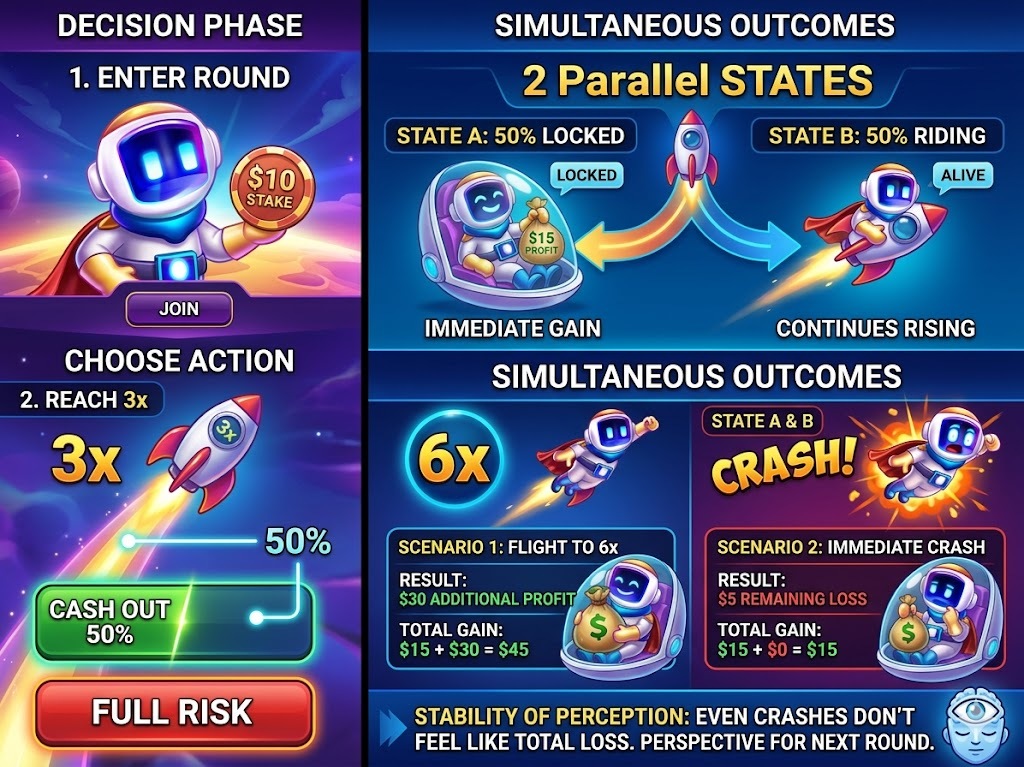
A player enters a round with a $10 stake and reaches a 3x multiplier. At this moment, instead of choosing between full exit or full risk, they activate the 50% cashout.
Half of the position is immediately secured. The other half continues riding the multiplier.
Now two things happen simultaneously. One part of the player’s outcome is already locked in profit. The other is still emotionally “alive” inside the game.
If the multiplier continues to 6x before crashing, the remaining half grows significantly. If it crashes immediately after activation, the player still retains meaningful profit from the locked portion.
The important detail here is not the outcome itself, but the stability of perception. Even in negative scenarios, the experience does not feel like a total loss. That alone changes how players approach the next round.
Why This Isn’t Just a “Safer Strategy”
It would be a mistake to call this mechanic purely defensive. That’s a shallow interpretation.
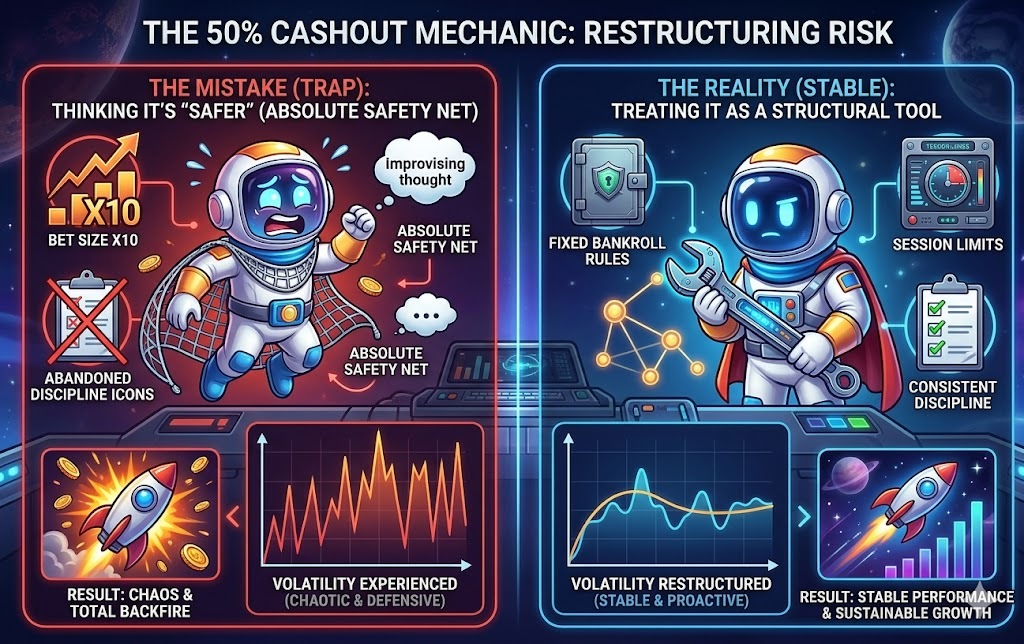
What it actually does is redistribute risk across time instead of eliminating it. You are not reducing volatility — you are restructuring how volatility is experienced.
This is why some players misuse it. They assume it makes the game safer in an absolute sense, so they increase bet sizes or abandon discipline. That usually backfires.
In controlled observation sessions, the most stable results came from players who treated 50% cashout as a structural tool, not a safety net. They combined it with fixed bankroll rules and consistent session limits rather than improvising round by round.
When the Mechanic Actually Works Best
The 50% cashout system performs best when the player is already operating within a disciplined framework. It is particularly effective during medium-volatility sessions, where the goal is not explosive growth but controlled accumulation of profit over time.
It also works well during recovery phases, when a player is rebuilding after losses and needs emotional stability more than aggressive upside.
However, it becomes less effective in highly aggressive strategies where the goal is maximum multiplier chasing. In those cases, splitting exposure can reduce peak upside potential, which may not align with the player’s intent.
The mistake is not using the mechanic. The mistake is using it without understanding what kind of session you are actually running.
How It Fits Into the Broader Spaceman Design
If you look at Spaceman online as a system rather than a single game, the 50% cashout feature is part of a larger design philosophy. The goal is not just to deliver random outcomes but to shape how players move through uncertainty.
Spaceman already slows down decision pressure through visual pacing and smooth multiplier progression. The partial cashout feature adds another layer on top of that: it reduces emotional binary thinking.
Instead of “win or lose,” the game pushes you toward “partial win with continuation risk.” That shift may sound small, but it fundamentally changes how sessions feel over time.
Demo Mode and Why It Matters More Than People Think
The Spaceman demo version is where this mechanic becomes genuinely educational. Without financial pressure, players can observe how their behavior changes when partial profits are introduced.
What typically happens is interesting. At first, players ignore the feature entirely and behave as if they are still in a binary system. After some repetition, they start experimenting. And eventually, they begin to recognize how strongly perception influences their timing decisions.
This is the point where demo mode stops being practice and starts becoming behavioral analysis.
It reveals patterns most players never notice in live Spaceman play sessions.
Registration Is Just the Starting Point
Completing registration and entering the game is the easiest part of the entire process. The real challenge begins when decisions start carrying emotional weight.
Spaceman doesn’t require complex mechanics to be understood. It requires awareness of how quickly perception can override logic under uncertainty.
And the 50% cashout system is one of the clearest examples of that dynamic in action.
Where to Learn More About Crash Mechanics
For players who want to go deeper into how crash systems behave, including comparisons between Spaceman and other titles, you can explore structured breakdowns on:
It provides additional context around Crash Game mechanics, including volatility behavior, session structure, and gameplay patterns across different titles like Spaceman.
Key Takeaway
The 50% cashout feature is not a trick and not a guarantee. It is a structural shift in how outcomes are experienced.
Once you understand it properly, you stop thinking in terms of single wins or losses. You start thinking in terms of exposure, timing, and emotional stability across an entire session.
And that’s where Spaceman quietly separates itself from simpler crash models.
Spaceman: 50% Cashout Explained