For decades, a simple grid of grey squares hid a digital minefield that challenged the logic, patience, and nerves of millions. Almost everyone who owned a personal computer in the 1990s and 2000s spent hours clicking through this minefield, sometimes out of genuine tactical interest, but more often to kill time while waiting for a dial-up internet connection.
Today, that identical grid-based suspense has undergone a dramatic transformation. It has migrated from local operating systems to the cutting edge of blockchain-based iGaming. The classic minefield mechanic is no longer just a free puzzle; it has become a structural pillar of the modern crypto-casino ecosystem.
To understand how a basic tool designed to teach people how to use a computer mouse became a multi-million-dollar betting phenomenon, we have to trace the evolution of the grid back to its mainframe roots.
The Pre-Windows Dawn: Mainframes and Logic Puzzles
While most people associate the minefield mechanic exclusively with Microsoft, the core concept of navigating a hidden grid using numerical clues dates back much further. Long before the graphical user interface (GUI) became mainstream, text-based strategy and logic games laid the foundation.
In the late 1960s and 1970s, games like Cube and later Relentless Logic (created by Conway, Hong, and Smith) tasked players with moving from one corner of a grid to another without stepping on hidden hazards. Relentless Logic, developed for MS-DOS in 1985, featured a concept remarkably close to what we know today. The player navigated a safe path through a field populated by concealed mines, relying on proximity indicators to survive.
However, these early iterations lacked the fluid pacing and mechanical feedback loops that would later turn the concept into a global obsession. They were academic exercises in mathematical deduction, contained within the sterile walls of early computing terminals.
The Microsoft Masterstroke: Onboarding the Masses
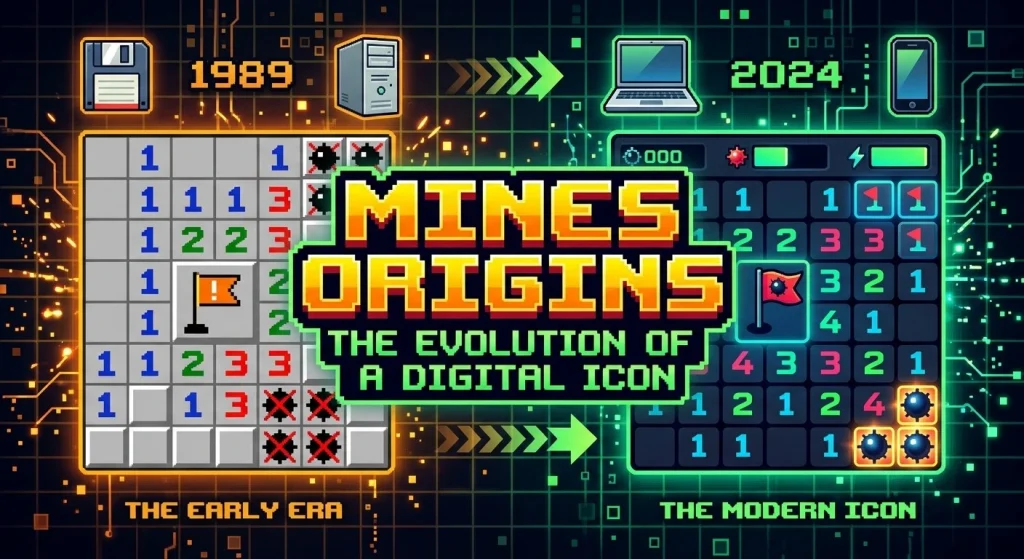
The true birth of the modern minefield legend occurred in 1990. Engineers Robert Donner and Curt Johnson, working at Microsoft, developed a game titled Minesweeper. It was initially released as part of the Microsoft Entertainment Pack for Windows, but its real breakthrough came when it was bundled natively into Windows 3.1 in 1992.
What many users didn't realize at the time was that Minesweeper was not included just for entertainment. It was a Trojan horse for digital literacy.
The Hidden Purpose of Minesweeper In the early 1990s, the computer mouse was an unfamiliar, clunky peripheral for a population used to command-line interfaces. Microsoft needed a frictionless way to train users in two critical physical skills: precision clicking (left-click to clear a square) and contextual command triggering (right-click to plant a flag).
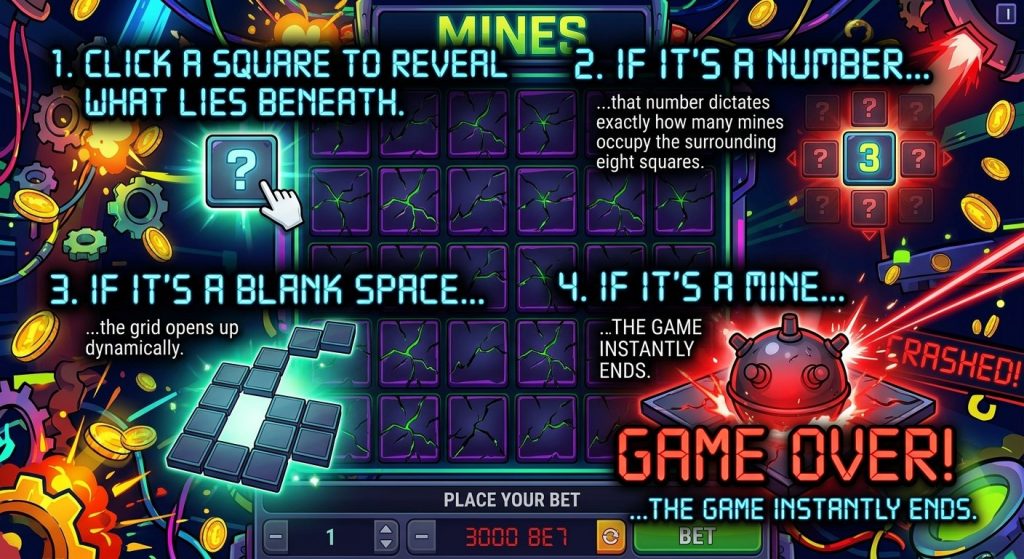
The game proved to be an addictive training manual. The rules were elegant in their simplicity:
Click a square to reveal what lies beneath.
If it’s a number, that number dictates exactly how many mines occupy the surrounding eight squares.
If it’s a blank space, the grid opens up dynamically.
If it’s a mine, the game instantly ends.
The psychological hook was immediate. Unlike games that required lightning-fast reflexes, Minesweeper demanded pure tactical deduction. It rewarded analytical thinking, yet it retained an element of raw, unpredictable luck on the very first click or when confronted with a mandatory 50/50 guessing scenario at the edge of a map.
The Core Psychology: Why the Grid Captivated Us
The human brain is naturally wired for pattern recognition and risk assessment. Minesweeper exploited these traits perfectly. Every click provided an immediate micro-dose of dopamine when a safe square was revealed, balanced by a sharp spike of tension when a high-number node (like a dreaded 5 or 6) appeared.
The mechanic introduced a brilliant balance of certainty and hazard. For 90% of a match, a skilled player could rely entirely on absolute logic. They could deduce the position of every single bomb with mathematical certainty. But that remaining 10%—the moments where the logic broke down and left two unmarked squares with a single mine remaining—introduced a pure gambling thrill.
It was this specific transition from pure logic puzzle to high-stakes guessing that set the stage for the game's ultimate rebirth decades later.
Shift to the Blockchain: The Crypto Metamorphosis
Fast forward to the mid-2010s. The rise of Bitcoin and early blockchain technology gave birth to a new generation of online gambling platforms. These platforms required games that were radically different from traditional, flashy, resource-heavy video slots found in legacy fiat casinos.
Early crypto adopters were developers, tech enthusiasts, and mathematicians. They preferred speed, minimal interfaces, transparent mechanics, and fast betting cycles. This environment sparked the creation of "Instant Games" or "Crash Games," and developers quickly realized that the classic Windows minefield mechanic was perfectly suited for this new paradigm.
Software providers like Spribe, alongside native crypto-casino development teams (such as Stake Originals), stripped away the complex, large-scale deductive elements of the 1992 classic. They distilled the concept down to its absolute, purest emotional core: risk customization.
The Structural Differences
Feature
Classic Windows Minesweeper
Modern Crypto Mines
Primary Goal
Clear the entire board using logic
Cash out before hitting a mine
Grid Size
Variable (9x9, 16x16, 30x16)
Standardized (usually 5x5)
Risk Control
Fixed presets (Easy, Medium, Hard)
Fully adjustable (1 to 24 mines)
Monetization
Free OS-bundled software
Variable wagers with scaling multipliers
Core Mechanic
Spatial deduction and elimination
Volatility management and luck
Deconstructing the Tech: How Crypto Mines Operates
In modern crypto Mines, the player faces a clean, usually 5x5 grid containing 25 facedown tiles. Before spinning or starting the round, the player decides two variables: their bet size and the number of hidden mines on the board.
If you choose to hide just 1 mine, your chances of picking a safe tile (represented by a diamond, coin, or star) are incredibly high, but the payout multiplier grows slowly. If you choose to hide 20 mines, the very first successful click yields a massive multiplier because the probability of survival is low.
The Magic of Provably Fair Algorithms
The defining feature that turned Mines into a staple of crypto-gaming is Provably Fair technology. In traditional online casinos, players had to blindly trust that a remote, hidden Random Number Generator (RNG) was fair. Crypto Mines completely flipped this dynamic by putting cryptographic proof directly into the player's hands.
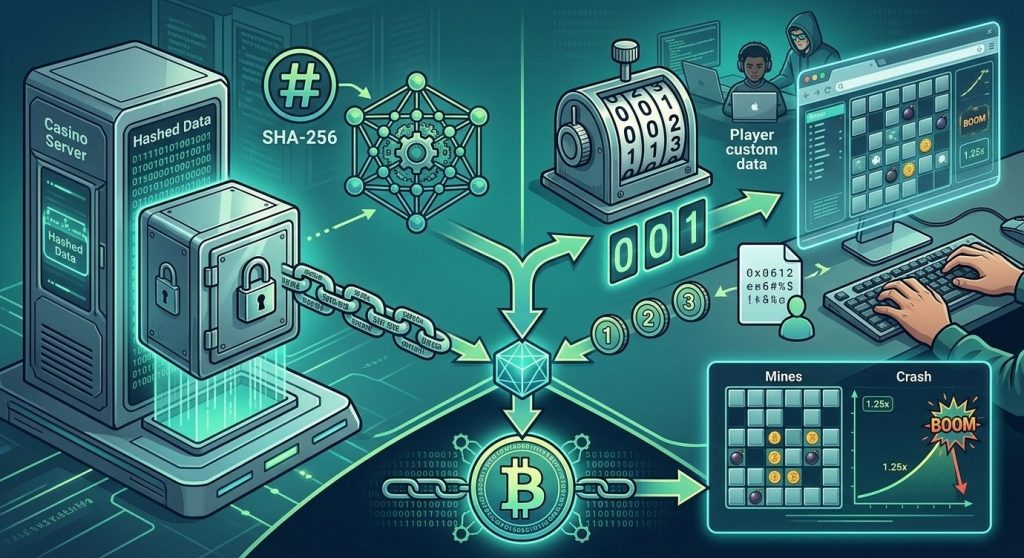
The game calculates outcomes using three distinct elements:
Server Seed: Provided by the casino platform (hashed beforehand so the player cannot see it).
Client Seed: Provided by the player’s browser (or custom-entered by the player), ensuring the casino cannot predict or manipulate the outcome.
Nonce: A counter that increments with every single bet placed during a session.
Before a round begins, the combination of these three strings creates a unique cryptographic hash (usually via SHA-256). This hash pre-determines the exact layout of the 25 tiles on the grid.
Because the client seed is mixed into the formula, the casino cannot alter the positions of the mines mid-game based on where the player clicks. After the round concludes, the player is given the unhashed server seed, allowing them to verify on an open-source ledger that the game was entirely honest.
Why It Conquered the Modern iGaming Market
The explosion of modern crypto Mines cannot be attributed to nostalgia alone. The game aligns flawlessly with the psychological preferences of modern digital consumers.
Absolute Autonomy: Traditional slot machines offer no real choice; you press a button and watch wheels spin. Mines gives the player complete agency. Do you cash out after two diamonds and take a safe 1.2x profit, or do you push for a fifth diamond to hit a 3x return? The player controls the exit strategy.
The "Near-Miss" Effect: When a player clicks a mine, the game instantly reveals where all the remaining safe diamonds were hidden. Seeing that a safe tile was right next to your cursor creates a powerful cognitive phenomenon known as the near-miss effect, prompting players to try "one more time" because victory felt incredibly close.
Perfect Mobile Scaling: The minimalist 5x5 grid design requires almost no bandwidth and renders perfectly on any mobile screen. It is frictionless, loads instantly, and allows for rapid-fire play sessions that fit into modern lifestyles.
The Legacy of the Minefield
The transformation of the minefield mechanic from a 1980s mainframe experiment to an iconic Windows feature, and finally into a multi-billion dollar crypto gaming pillar, showcases the enduring power of simple, elegant design.
By merging the timeless suspense of hidden hazards with the absolute transparency of blockchain verification, Mines has secured its place in gaming history. It proves that you don't need sprawling worlds or cinematic graphics to capture the global imagination—sometimes, all it takes is a grid, a hidden threat, and the intoxicating thrill of the next click.
Minesweeper vs Crypto Mines FAQ
What is the main difference between classic Windows Minesweeper and crypto Mines?
The core objective and endgame are completely different. In the classic Windows game, your goal was to clear the entire board using mathematical logic and spatial numbers. In crypto Mines, it’s all about volatility and profit management. You don’t get numerical clues, and you don’t need to clear the board—you just try to hit a few safe spots and cash out before hitting a mine.
Can a crypto casino change the location of the mines mid-game?
No, as long as you are playing on a reputable platform that uses Provably Fair technology. The positions of all mines are determined by a cryptographic hash before you make your very first click. Because your browser's client seed is mixed into that algorithm, the casino cannot manipulate or shift the layout while you play.
Is there a winning strategy for crypto Mines?
Unlike the original 1990s game, which was a pure deduction puzzle, crypto Mines is inherently a game of chance. There is no strategy that guarantees a win. The best approach is disciplined bankroll management—choosing a risk level (number of mines) that fits your budget and setting a strict target for when to press the cash-out button.
Why did Microsoft originally create Minesweeper?
It was actually a clever onboarding tool masquerading as a game. In the early 1990s, most people were used to typing commands and didn't know how to use a computer mouse. Microsoft bundled Minesweeper into Windows 3.1 to teach users precision movement, left-clicking to clear squares, and right-clicking to plant flags.
How does the number of mines affect the payouts?
The math is simple: more mines equal higher multipliers but lower odds of survival. If you set the game to hide 20 mines on a 5x5 grid, even finding just one diamond will yield a massive payout because the probability of hitting a safe spot is so low. Conversely, hiding only 1 or 2 mines gives you a very safe game, but the multipliers will grow much slower.