



Why “Strategy” in Crash Games Is Usually Misunderstood
Most beginners approach Crash Game systems like Spaceman or similar titles with one assumption: there must be a pattern that predicts the next multiplier.
That assumption collapses quickly under real conditions.
After analyzing long sessions of Spaceman play, one thing becomes obvious — outcomes don’t become predictable, but player behavior does. And that’s where strategy actually lives.
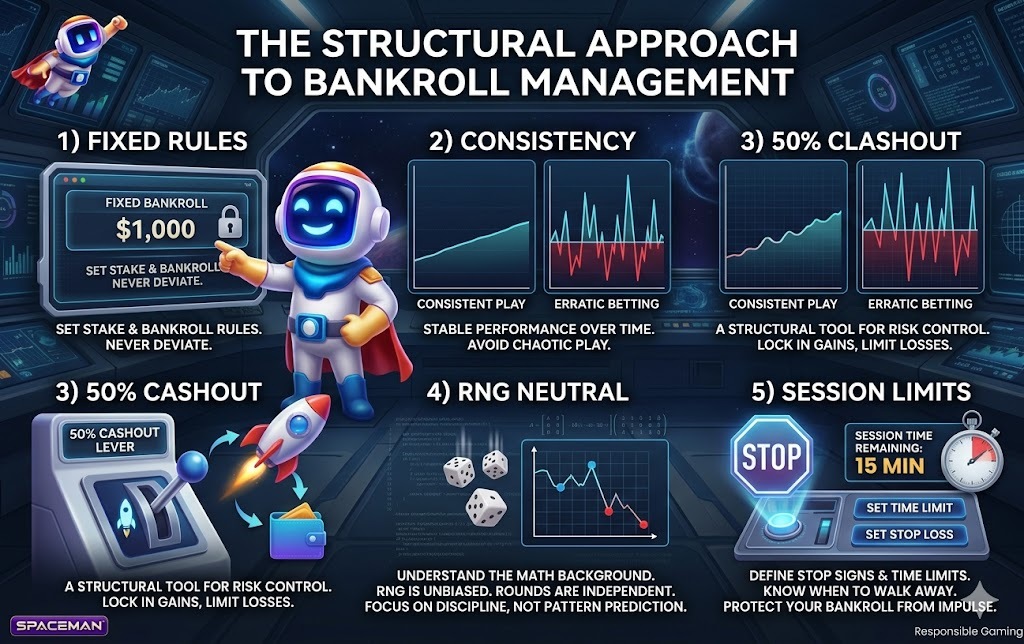
The real edge isn’t prediction. It’s structure.
Players who last longer aren’t guessing better. They are simply controlling exposure more consistently while balancing aggressive and conservative phases inside the same bankroll.
The Core Idea: Split Your Game Into Two Modes
The most stable betting approach we’ve observed in practice is not a single system but a dual-mode structure.
Instead of trying to find “one perfect strategy,” experienced players switch between two internal states:
Conservative Mode
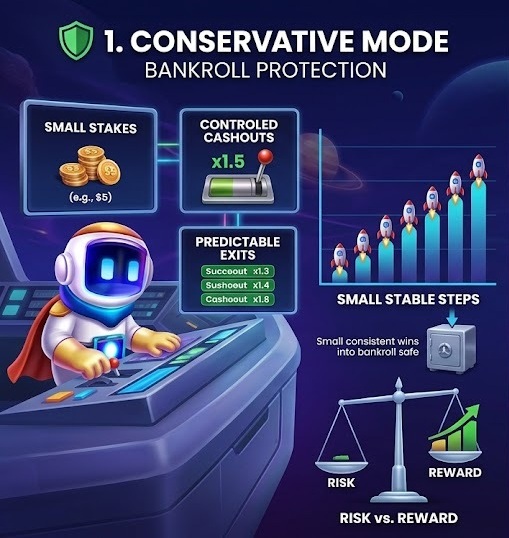
This is where bankroll protection happens. Small stakes, controlled cashouts, and predictable exits. It’s the foundation that keeps you in the game long enough for variance to work in your favor.
Aggressive Mode
This is where upside is chased. Higher multipliers, more volatility, and acceptance of longer losing streaks. It’s not constant — it’s situational.
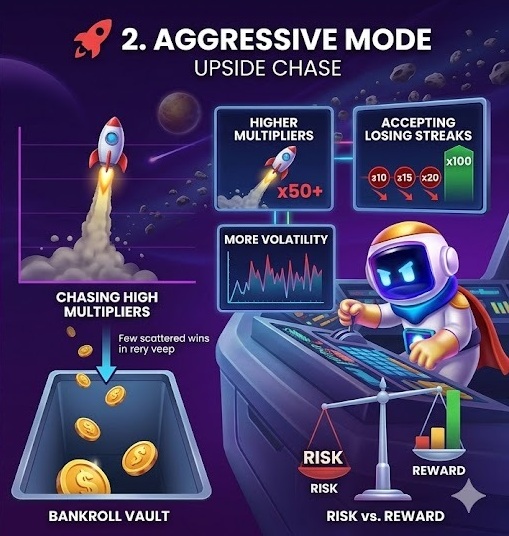
The mistake most players make is staying in aggressive mode permanently. That’s what leads to fast bankroll collapse.
Conservative Play: Semi-Auto Cashout Discipline
Conservative strategies are often underestimated because they feel “slow.” But in reality, they are what keeps sessions alive.
A semi-auto cashout approach means setting a fixed exit range (for example 1.5x–2.0x) and refusing to deviate based on emotion.
In real session analysis, players using consistent low multipliers tend to experience:
- smoother bankroll curves
- fewer emotional spikes
- longer survival during losing streaks
- more stable session outcomes
The key here is not profit size—it’s variance control.
Even during extended downturns, conservative systems avoid catastrophic drawdowns, which is where most players fail.
Conservative Play: Semi-Auto Cashout Discipline
Conservative strategies are often underestimated because they feel “slow.” But in reality, they are what keeps sessions alive.
A semi-auto cashout approach means setting a fixed exit range (for example, 1.5x–2.0x) and refusing to deviate based on emotion.
In real session analysis, players using consistent low multipliers tend to experience:
- smoother bankroll curves
- fewer emotional spikes
- longer survival during losing streaks
- more stable session outcomes
The key here is not profit size—it’s variance control.
Even during extended downturns, conservative systems avoid catastrophic drawdowns, which is where most players fail.
Aggressive Play: Controlled Multiplier Chasing
Aggressive strategies are where excitement lives, but also where discipline breaks fastest.
High-multiplier chasing is not inherently bad. The problem is randomness interpretation. Players often increase stakes after short-term losses or chase “recovery” rounds, which creates exponential risk escalation.
A structured, aggressive approach avoids that.
Instead of reacting to outcomes, it defines:
- fixed aggressive rounds
- predefined risk percentage
- strict stop-loss per session
In observed Spaceman online sessions, aggressive phases work best when they are short, intentional, and separated from conservative gameplay rather than mixed randomly.
The Hybrid System: Where Most Strong Players Operate
The most consistent approach is not extreme conservatism or full aggression — it’s switching between both.
A typical structured session looks like this:
You start in conservative mode to build stability. Once a small profit threshold is reached, you allocate a portion of that profit into aggressive rounds. If variance turns negative, you immediately revert back to conservative play.
This creates a cycle:
stability → opportunity → reset
Instead of chasing wins, you manage exposure cycles.
That is the closest thing to “optimization” that actually works in environments driven by RNG-based outcomes.
Bankroll Allocation: The Part Most Players Ignore
Strategy without bankroll segmentation usually fails.
A practical structure separates funds into psychological zones rather than just numbers.
One portion is reserved for survival—the part you never aggressively risk. Another portion is flexible—used for testing higher volatility behaviors. The last portion is experimental—where aggressive Spaceman play happens without affecting overall stability.
This prevents one bad sequence from destroying your entire session psychology.
Because in reality, most losses are not mathematical—they are emotional cascades triggered by poor segmentation.
Why Semi-Auto Cashout Beats Manual Decisions
Manual cashout sounds flexible, but in practice it introduces inconsistency.
During volatility spikes, players tend to:
- exit too early during winning streaks
- hold too long during fear phases
- overreact after small losses
Semi-auto systems remove that decision pressure.
When you predefine exit points, you are no longer “deciding” under stress. You are executing a rule.
And in crash game environments, rule execution consistently outperforms emotional adaptation.
The Role of Demo Testing in Strategy Building
The Spaceman demo environment is where strategy becomes measurable instead of theoretical.
Without financial pressure, you can observe:
- how often conservative systems survive long streaks
- how aggressive phases behave under repeated variance
- how emotional decision-making starts to appear even without real money involved
In repeated testing, behavior consistency in demo mode strongly correlates with real-money performance patterns later on.
Not because the game changes—but because habits carry over.
Registration Is Not Strategy—Discipline Is
Completing registration and entering the game is not the hard part. Anyone can start playing in minutes.
The real difficulty begins when variance stops matching expectations.
That’s where structure matters more than intuition.
Without predefined rules, even the best theoretical strategy collapses under emotional pressure.

Proven Betting Strategies for Spaceman