



Why Understanding the Math Behind Lucky Jet Matters

Many players focus entirely on multipliers.
They watch the plane climb, hope for a big cash-out, and assume that recent results somehow influence the next round. After a streak of low multipliers, some expect a huge flight. After a massive multiplier appears, others believe another one is unlikely to arrive soon.
The reality is different.
The mathematics behind Lucky Jet doesn’t care about previous outcomes, player emotions, or betting history. Every round is generated independently, using algorithms designed to produce random and unpredictable results.
Understanding how RTP, RNG, volatility, and house edge actually work can help players make smarter decisions and avoid some of the most common misconceptions surrounding this popular Crash Game.
By the end of this guide, you’ll understand what these numbers mean, how they affect your bankroll, and why many players misunderstand them entirely.
How Lucky Jet Works Behind the Scenes
Lucky Jet appears simple.
A plane takes off.
The multiplier rises.
Players can cash out at any moment before the flight crashes.
What happens behind the interface is far more interesting.
Each round begins with a mathematical process that generates the final crash point before the flight even starts.
The animation you see is simply a visual representation of a result that has already been determined.
This process relies on a Random Number Generator (RNG), which creates unpredictable outcomes for every round.
Because each round is generated independently:
- Previous multipliers do not affect future multipliers.
- Winning streaks do not increase crash probability.
- Losing streaks do not guarantee a recovery.
- Patterns visible to players are usually coincidences.

This principle is known as statistical independence.
It forms the foundation of every modern online crash game.
What Is RNG and Why Does It Matter?
RNG stands for Random Number Generator.
In online gambling, RNG systems generate unpredictable results that determine game outcomes.
In Lucky Jet, the RNG contributes to deciding where the multiplier will stop.
The most important thing to understand is this:
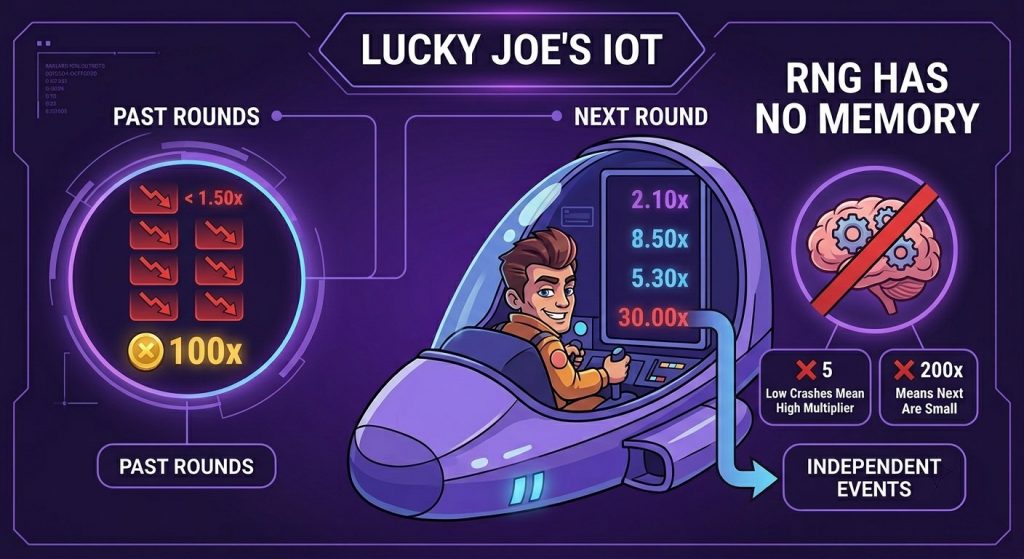
RNG has no memory.
If the last ten rounds crashed below 1.50x, the next round is not “due” for a higher multiplier.
Likewise, a recent 100x multiplier does not reduce the chance of another large multiplier appearing shortly afterward.
Many players fall victim to what mathematicians call the Gambler’s Fallacy.
This occurs when someone assumes past outcomes influence future independent events.
For example:
- “Five low crashes in a row means a high multiplier is coming.”
- “A 200x just appeared, so the next few rounds will be small.”
Neither statement is supported by probability theory.
The Mathematics of Crash Multipliers
Crash games create an unusual distribution of outcomes.
Low multipliers occur frequently.
High multipliers occur less often.
Extremely large multipliers occur very rarely.
A simplified illustration looks like this:
| Multiplier Range | Frequency |
| 1.00x – 1.50x | Very Common |
| 1.50x – 3.00x | Common |
| 3.00x – 10.00x | Less Common |
| 10.00x – 50.00x | Rare |
| 50.00x+ | Very Rare |
This uneven distribution is what creates excitement.
Players frequently experience small wins while occasionally witnessing enormous multipliers that generate attention and social proof.
However, those spectacular flights occur far less often than most players realize.
RTP Explained in Plain English
One of the most misunderstood concepts in gambling is RTP.
RTP stands for Return to Player.
It represents the theoretical percentage of wagered money that is returned to players over a very large sample size.
For example:
If a game has an RTP of 97%:
- Players collectively wager $100,000.
- Approximately $97,000 returns to players.
- Approximately $3,000 remains as casino revenue.
The missing percentage is known as the house edge.
RTP Example
| Total Bets | RTP | Returned to Players | House Edge |
| $1,000 | 97% | $970 | $30 |
| $10,000 | 97% | $9,700 | $300 |
| $100,000 | 97% | $97,000 | $3,000 |
The key word here is theoretical.
RTP does not apply to a single session.
It applies across millions of rounds.
A player may experience results that are significantly above or below the published RTP during a short playing session.
Why RTP Doesn’t Guarantee Profits
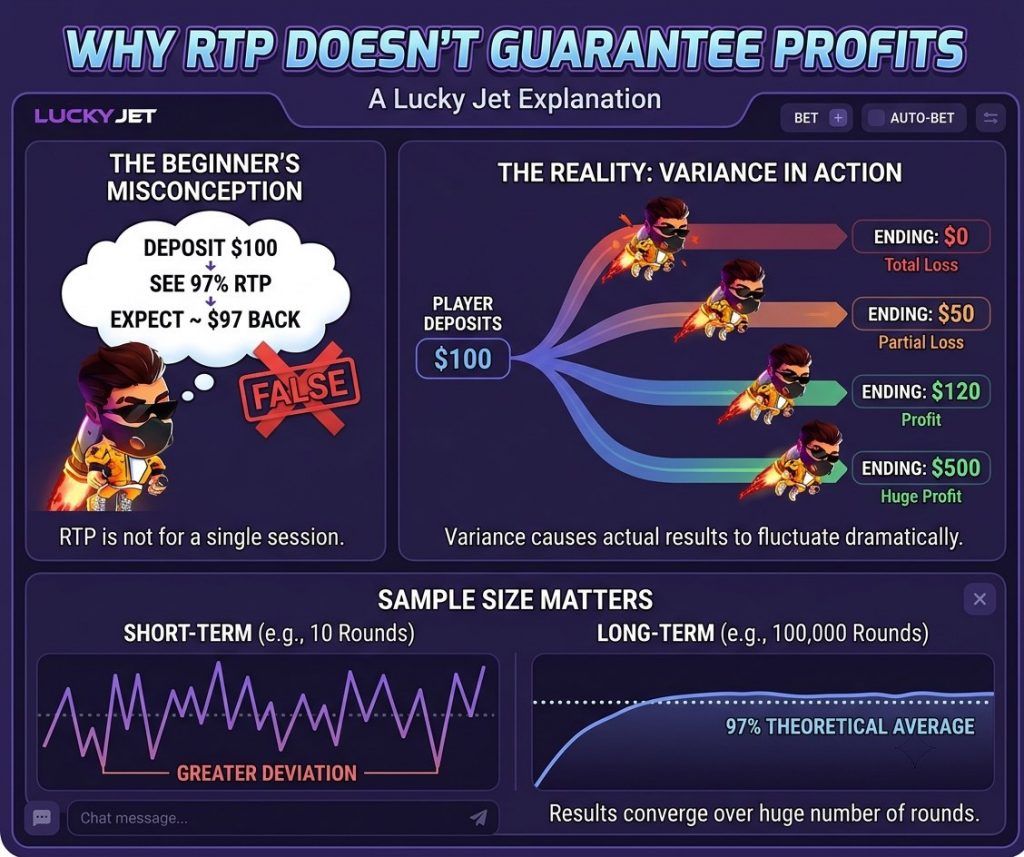
Why RTP Doesn’t Guarantee Profits
Many beginners incorrectly interpret RTP as an expected session result.
Imagine a player deposits $100 into Lucky Jet play.
Seeing an RTP near 97% might suggest they should finish with approximately $97.
That is not how RTP works.
Possible outcomes include:
- Ending with $0.
- Ending with $50.
- Ending with $120.
- Ending with $500.
Variance causes actual results to fluctuate dramatically around the theoretical average.
The smaller the sample size, the greater the deviation.
This is why short-term experiences often look completely different from long-term mathematical expectations.
Understanding the House Edge
The house edge is simply the mathematical advantage built into the game.
Without it, casinos could not operate profitably.
The relationship is straightforward:
If RTP equals 97%, the house edge equals 3%.
This does not mean the casino wins 3% every day.
Instead, it means that over an enormous number of rounds, the mathematical expectation favors the operator by approximately 3%.
The house edge works slowly but relentlessly.
That is why bankroll management remains critical even in games with relatively high RTP values.
Volatility: The Hidden Factor Most Players Ignore
While RTP receives most of the attention, volatility often has a greater impact on individual sessions.
Volatility measures how dramatically results fluctuate.
Low Volatility
- Frequent small wins.
- Slower bankroll swings.
- More predictable sessions.
High Volatility
- Longer losing streaks.
- Bigger winning opportunities.
- Larger bankroll fluctuations.
Crash games like Lucky Jet generally produce moderate-to-high volatility compared with many traditional casino products.
This explains why players can experience dramatic gains or losses within relatively short periods.
Why Chasing Patterns Usually Fails
During testing, we repeatedly observed players creating theories based on recent results.
Examples include:
- Entering after three low crashes.
- Waiting for a high multiplier before betting.
- Following “hot streaks.”
- Tracking previous flight paths.
The problem is simple.
Independent RNG outcomes do not create predictive patterns.
Humans naturally search for order, even where none exists.
In practice, most pattern-based systems fail because they confuse coincidence with causation.
The numbers may look meaningful.
The mathematics says otherwise.
Registration, Demo Mode, and Learning the Numbers
Before completing registration and playing with real money, players should spend time understanding how the game behaves.
The Lucky Jet demo version offers an ideal environment for this.
Use demo mode to:
- Observe volatility.
- Track multiplier frequency.
- Test bankroll strategies.
- Understand emotional decision-making.
- Practice cash-out timing.
Many players learn more from several hundred demo rounds than from reading dozens of strategy articles.
The goal is not predicting outcomes.
The goal is becoming comfortable with variance.
Interactive Feature Recommendation
To increase dwell time and provide genuine value, place a Lucky Jet RTP & Probability Calculator below this article.
Recommended inputs:
- Starting bankroll.
- RTP percentage.
- Average bet size.
- Number of rounds.
- Cash-out multiplier target.
The calculator can estimate expected variance ranges and demonstrate why short-term results often differ from theoretical RTP.
This helps readers visualize concepts that are otherwise difficult to understand.
Key Takeaways
The mathematics behind Lucky Jet is far less mysterious than many players believe.
A few principles explain almost everything:
- Every round is generated independently.
- RNG outcomes have no memory.
- RTP reflects long-term expectations, not short-term results.
- The house edge creates a mathematical casino advantage.
- Volatility causes significant bankroll fluctuations.
- No betting strategy can predict future multipliers consistently.
What it will do is help you approach Lucky Jet with realistic expectations, stronger bankroll discipline, and a better understanding of how the game actually works.
Lucky Jet: RTP & Mechanics