



The landscape of modern instant-win crypto gaming has shifted away from passive consumption toward active mathematical engagement. Traditional slot machines relegate the player to a spectator, where fixed mechanics determine outcomes along predefined paylines. In contrast, the modern minefield mechanic—best exemplified by the game Mines—introduces a dynamic choice architecture. By placing the parameters of risk, probability, and reward directly into the hands of the player, it transforms a basic guessing game into a sophisticated exercise in discrete mathematics and behavioral psychology.
To navigate this interface effectively, one must move past surface-level intuition and analyze the underlying mechanics. Every decision made within the game—from selecting the initial configuration to executing a cash-out strategy—alters the statistical landscape of the board. This article breaks down the precise mathematical structures governing grid dynamics, probability distribution, and multiplier scaling.
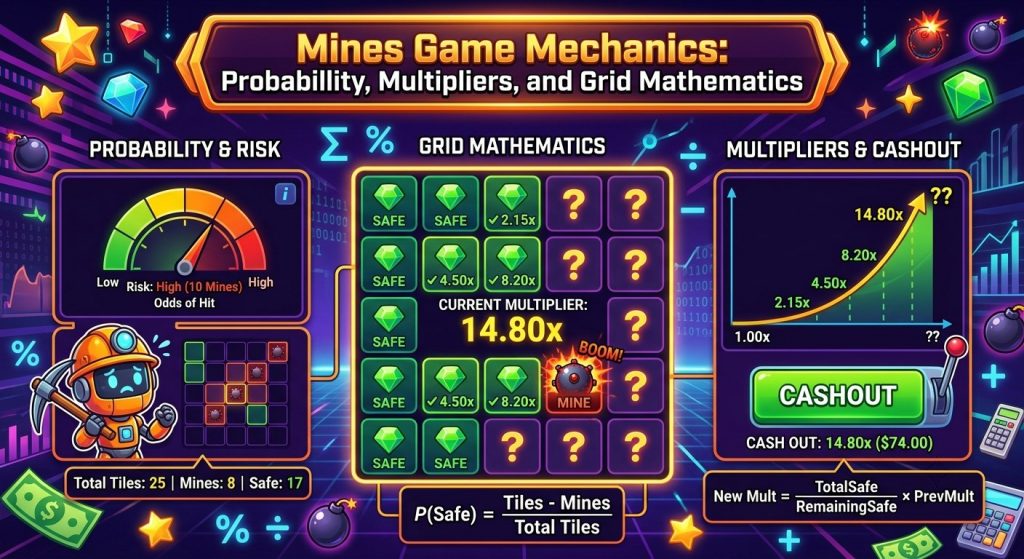
The Geometry of the Grid: Dimensions and Combinatorial Foundations
The standard matrix for modern crypto Mines is a fixed 5 X 5 grid, establishing a finite field of exactly 25 discrete tiles (N = 25). While alternative configurations occasionally appear in niche software variants, the 5 X 5 layout has become the industry benchmark due to its optimization for cognitive processing and mobile user interfaces.
Within this 25-tile system, the board exists in a binary state: a tile is either “safe” (containing a diamond, star, or coin multiplier) or “hazardous” (containing a mine). The total number of hidden mines (M) is completely customizable by the user, typically restricted to a range of 1 ≤ M ≤ 24. This single configuration parameter alters the total volume of possible board arrangements. The absolute number of unique ways to distribute a specified number of mines across the grid is calculated using the standard combinatorial formula for combinations without repetition:
Where N represents the total number of tiles (25) and M represents the chosen mine count. For instance, if a player configures a game with exactly 3 mines, the number of distinct ways those mines can be distributed across the 25 hidden positions is:
Conversely, if the player increases the difficulty to 10 mines, the combinatorial complexity expands exponentially:
This massive variance in distribution arrangements underpins the randomness and security of the game, making pattern tracking or layout prediction mathematically impossible when powered by a verified cryptographic random number generator.
Probability Decay: The Mechanics of Successive Selection
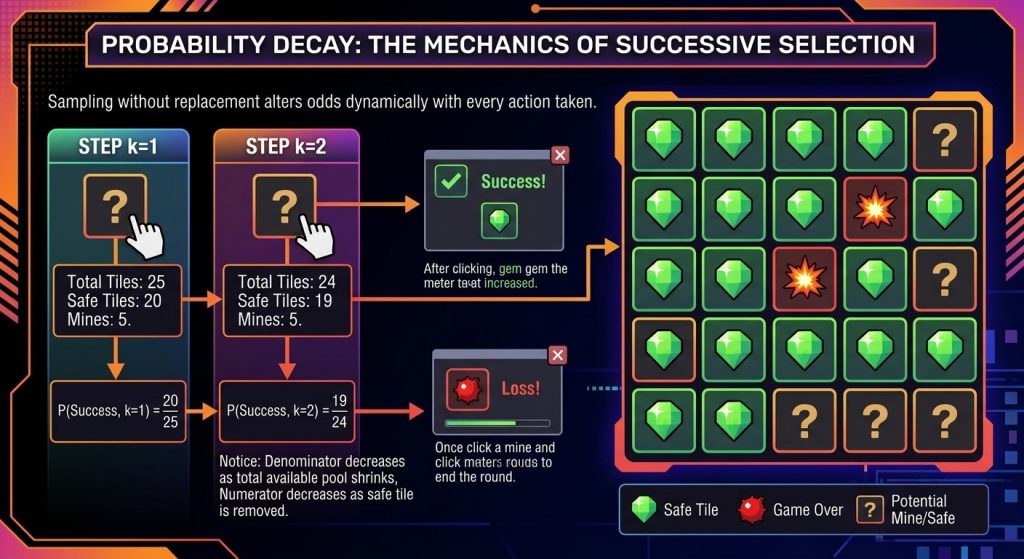
The defining operational element of Mines is that every safe selection removes a non-hazardous tile from the remaining pool. This is a textbook example of sampling without replacement, governed by the hypergeometric distribution. Consequently, the probability of winning does not remain static from click to click; it alters dynamically with every action taken on the interface.
Let k represent the number of successful consecutive clicks achieved in a single round. For the very first selection (k = 1), the probability of choosing a safe tile is a direct ratio of the total safe tiles to the total available tiles:
Assuming a standard setup of 5 mines, the initial safe tiles equal 20 (25 – 5). The probability of a successful first click is therefore 20 / 25 = 0.80 or 80%. If the tile is safe, the game state updates. The total pool of hidden tiles decreases to 24, and the remaining pool of safe tiles decreases to 19. The probability of succeeding on the second consecutive click (k = 2) becomes:
To calculate the cumulative probability of surviving a sequence of k clicks without triggering a mine, we must multiply the conditional probabilities of each successive step. The general formula for cumulative survival probability is expressed as:
This formula demonstrates a clear curve of probability decay. As the player uncovers more diamonds, the concentration of mines among the unselected tiles grows denser, accelerating the risk of failure with each subsequent step. The odds of hitting a mine increase because the denominator shrinks faster than the numerator in relation to hazardous elements.
Multiplier Scaling and House Edge Integration
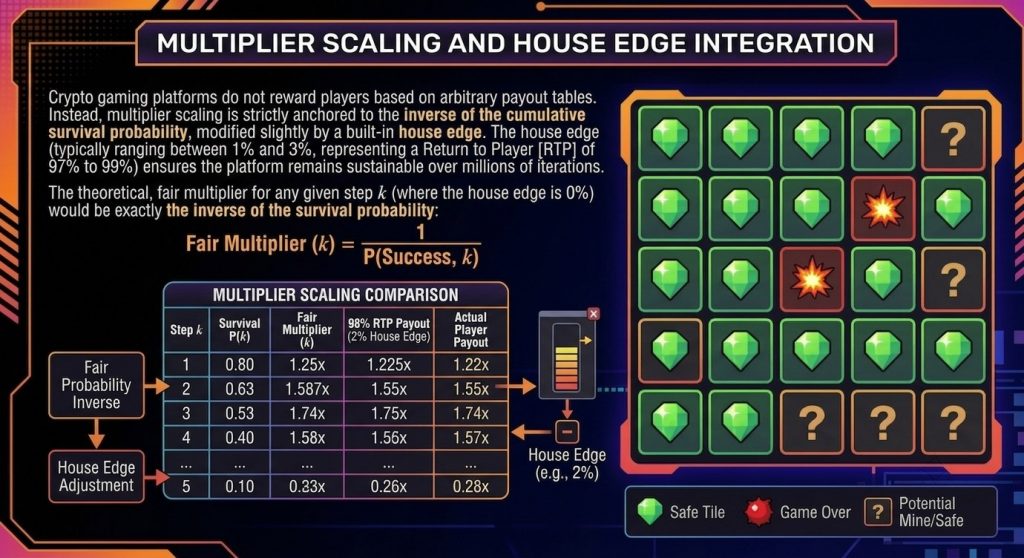
Crypto gaming platforms do not reward players based on arbitrary payout tables. Instead, multiplier scaling is strictly anchored to the inverse of the cumulative survival probability, modified slightly by a built-in house edge. The house edge (typically ranging between 1% and 3%, representing a Return to Player [RTP] of 97% to 99%) ensures the platform remains sustainable over millions of iterations.
The theoretical, fair multiplier for any given step k (where the house edge is 0%) would be exactly the inverse of the survival probability:
To calculate the actual game multiplier displayed on the user interface, software developers inject the RTP factor into the equation:
Let us look at a real-world calculation example. Using a configuration of 3 mines (M = 3, safe tiles = 22) and assuming a standard house edge of 1% (RTP = 0.99), let’s calculate the multiplier scaling for the first three consecutive safe clicks:
Multiplier Growth Table (3 Mines, 1% House Edge)
- Step 1 (k=1): * Step Probability: 22 / 25 = 0.8800
- Cumulative Survival Probability: 0.8800
- Theoretical Fair Multiplier: 1.1363x
- Actual Display Multiplier: 1.12x
- Step 2 (k=2): * Step Probability: 21 / 24 = 0.8750
- Cumulative Survival Probability: 0.8800 x 0.8750 = 0.7700
- Theoretical Fair Multiplier: 1.2987x
- Actual Display Multiplier: 1.28x
- Step 3 (k=3): * Step Probability: 20 / 23 ≈ 0.8695
- Cumulative Survival Probability: 0.7700 x 0.8695 = 0.6695
- Theoretical Fair Multiplier: 1.4935x
- Actual Display Multiplier: 1.47x
This structured progression reveals that multiplier growth accelerates as the game progresses deep into the grid. The scaling curve is non-linear; it steepens significantly because the mathematical difficulty of surviving increases with every tile removed from the matrix. The further you venture, the more rewarding each individual click becomes relative to the previous one.
The most extreme manifestation of multiplier scaling occurs when a user configures the board with 24 mines and only 1 safe tile. The probability of selecting that single diamond on the first click is exactly 1 / 25 = 0.04 (4%). Factoring in a standard house edge, the actual multiplier instantly jumps to roughly 24.75x. A single correct choice ends the game immediately with a massive return, illustrating the absolute limits of risk configuration within the interface.
Interface Anatomy and Tactical Input Systems
To master the game of Mines, a player must look past the visual aesthetics and fully understand the operational interface. The modern crypto gaming interface is built to facilitate high-speed, frictionless interactions while giving users meticulous control over their risk parameters.
Bet Configuration Control
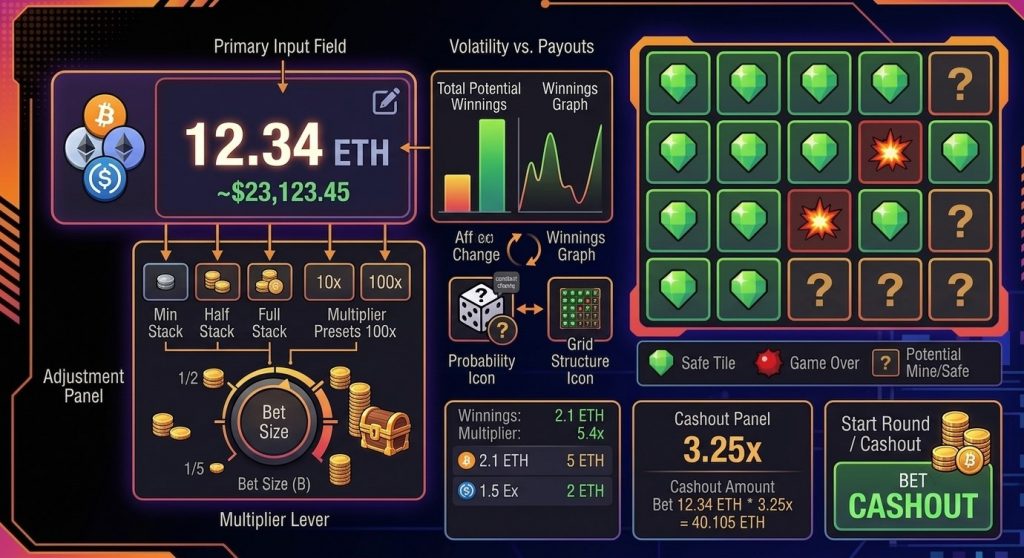
The primary input field dictates the wager size per round, typically allowing values ranging from fractions of a cent up to thousands of dollars equivalent in cryptocurrency. Because payouts are expressed strictly as multipliers, your bet size serves as the baseline variable for all financial outcomes. Modifying this field alters the absolute volatility of your session without affecting the statistical probabilities of the grid itself.
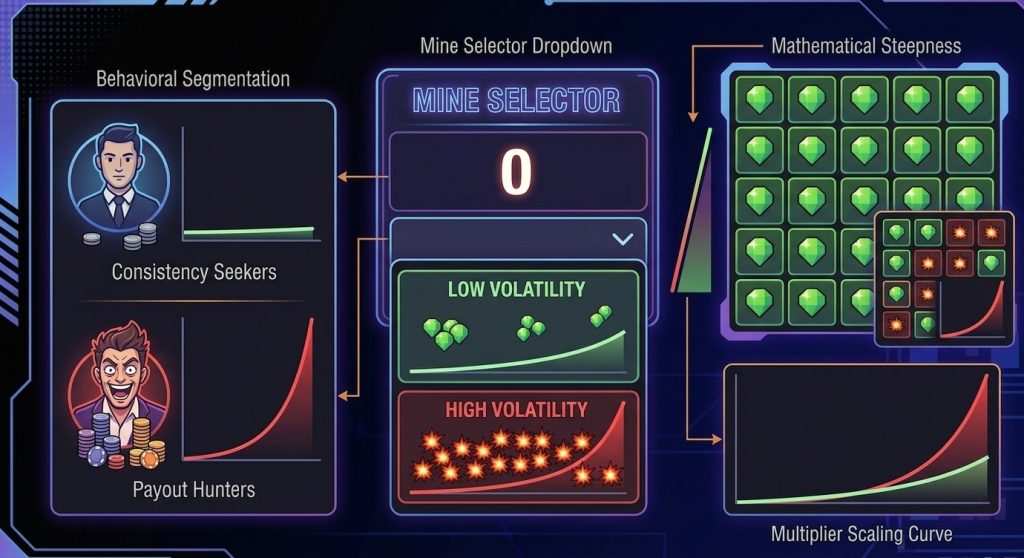
The Mine Selector Dropdown
This interface component acts as the manual toggle for the game’s volatility index. By adjusting the mine count, the user directly changes the mathematical steepness of the multiplier scaling curve. This architectural choice splits players into distinct behavioral segments: those seeking consistent, micro-returns via low mine configurations and those hunting high-exponential payouts via dense mine fields.
Manual Selection vs. Automated Systems
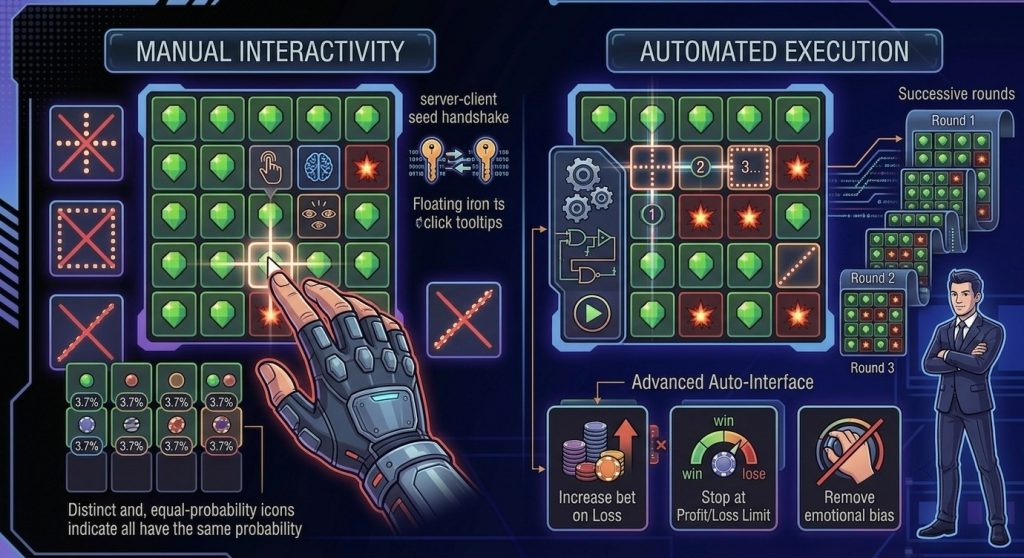
Modern implementations feature two primary modes of grid interaction:
- Manual Interactivity: The player clicks individual tiles based on subjective choice, intuition, or visual patterns. It is critical to recognize that because mine placement is completely randomized via a server-client seed handshake, no visual pattern (e.g., clicking in a cross, border, or diagonal) holds any mathematical advantage over any other pattern. Every unrevealed tile carries an identical real-time probability of hazard.
- Automated Execution (Auto Mode): This interface extension allows players to pre-program a specific pattern of tiles to be clicked automatically across a sequence of multiple rounds. Advanced auto-interfaces include specific behavioral modifiers, such as “Increase bet by X% on loss” (Martingale scaling) or “Stop execution if profit/loss exceeds Y.” This detaches emotional bias from gameplay, turning the interface into a systematic execution tool.
Risk Architecture and Strategic Paradigms
Every strategy applied to the game of Mines is fundamentally an attempt to manage the balance between probability decay and multiplier scaling. Because the mathematical expectation (EV) of every single click is slightly negative due to the house edge, no strategy can mathematically guarantee long-term profitability. However, players can utilize specific risk architectures to align the game’s variance with their specific capital preservation goals.
The Conservative Extraction Model (Low Mines, Minimal Clicks)
In this paradigm, the user configures the interface to a low threat level (e.g., 1 to 3 mines) and restricts their activity to 1 or 2 clicks per round. The probability of survival is exceptionally high (often exceeding 85%), resulting in frequent, small wins. This approach minimizes session variance, creating a stable, incremental grind. The primary hazard here is that a single loss requires a lengthy sequence of consecutive successful rounds to recover the lost capital.
The High-Volatility Infiltration Model (High Mines, Single Click)
This strategy completely flips the risk profile. The user sets the mine count to an aggressive level (e.g., 15 to 20 mines) and attempts to clear only a single tile. The survival rate drops significantly, but a single successful click yields a substantial multiplier (e.g., 3x to 5x your wager). This model embraces high variance, accepting frequent immediate losses in exchange for rapid balance inflation when a safe tile is successfully located.
The Deep Grid Journey (Medium Mines, High Clicks)
This hybrid approach involves setting a balanced mine count (e.g., 5 mines) and attempting to press deep into the board, uncovering 5 to 10 tiles. This strategy leverages the non-linear scaling of the multiplier curve. As the survival probability drops with each step, the compounding returns grow exponentially. This approach demands a disciplined cash-out strategy, as greed frequently drives players to click past the mathematical tipping point where the risk completely eclipses the marginal reward.
Conclusion: Knowledge as the Ultimate Risk Mitigation Tool
The mastery of modern crypto Mines does not rely on luck or unverified guessing patterns. It requires a firm grasp of discrete probability, a clear understanding of how the house edge influences multiplier scaling, and absolute discipline when using the interface controls. By treating the $5 \times 5$ grid as a fluid mathematical field rather than a visual guessing game, players can systematically control variance, execute precise tactical frameworks, and fully appreciate the elegant mechanics that make this game a structural masterpiece of the digital iGaming era.
Mines Multipliers & Mechanics FAQ