



Every instant-win crypto game presents a fundamental mathematical reality: the house edge is explicitly integrated into the payout structures. In a standard 5 x 5 grid matrix, where players attempt to uncover safe tiles while avoiding hidden hazards, the mathematical expectation (EV) of any individual click remains slightly negative. Therefore, the concept of a “winning strategy” in the game of Mines does not imply a mechanical hack or a guaranteed long-term profit formula. Instead, true tactical mastery relies on variance mitigation, systematic capital allocation, and risk architecture customization.
To maximize your probability of walking away with a profit, you must understand how to combine mathematical betting progressions with strict bankroll management frameworks while systematically eliminating emotional decision-making from your sessions.
The Fallacy of Fixed-Mine Patterns and Geometric Betting
A common phenomenon among recreational players is the reliance on fixed-mine patterns or specific geometric configurations on the interface. Players often click the grid in predefined shapes—such as corners, crosses, diagonals, or perimeter borders—under the mistaken belief that these sequences possess a statistical advantage or “cold/hot” tendencies.
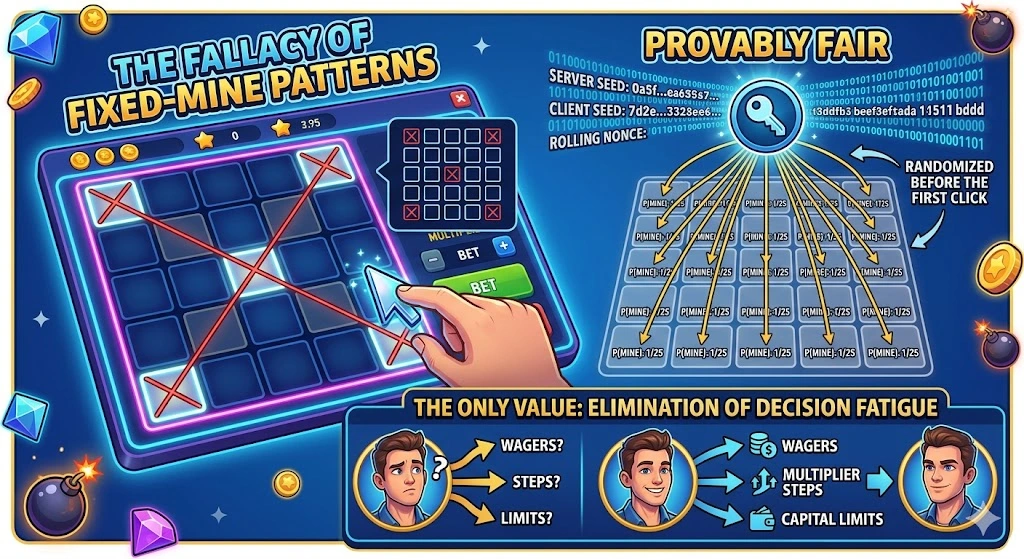
From a cryptographic standpoint, this approach is fundamentally flawed. In modern iGaming platforms running on Provably Fair protocols, the positions of the mines are determined via a combined cryptographic hash of the server seed, client seed, and a rolling nonce before the first click occurs. Because every single unrevealed tile on the 5 x 5 matrix shares an identical real-time probability of containing a hazard, choosing an anchor pattern is merely a psychological comfort rather than a mathematical shield.
The only value a fixed pattern offers is the elimination of decision fatigue. By clicking the same designated squares every round, a player removes hesitation from the equation, allowing them to focus entirely on what actually controls their bottom line: wagers, multiplier steps, and automated capital limits.
Progression Betting Systems in the Minefield
When executed with precise discipline, progression betting systems allow players to adjust their wagers dynamically based on the outcomes of previous rounds. These systems work best when tailored to the specific volatility profile of your chosen mine configuration.
The Martingale Approach: Negative Progression for High-Probability Setups
The Martingale strategy is the most famous betting system in the world, requiring the player to double their wager after every loss. The goal is to recover all cumulative losses and secure a baseline profit equal to the original stake with a single victory.
In Mines, the classic 1:1 payout requirement of the Martingale system does not perfectly align with the non-linear multiplier scaling curve. To execute a true Martingale, you must target a specific multiplier milestone—typically around 2.00x. For example:
- Setting the board to 3 mines and successfully clicking 4 consecutive safe tiles yields roughly a 1.70x to 2.00x multiplier depending on the software’s house edge.
- Setting the board to 5 mines and successfully clicking 3 consecutive safe tiles quickly breaches the 2.00x threshold.
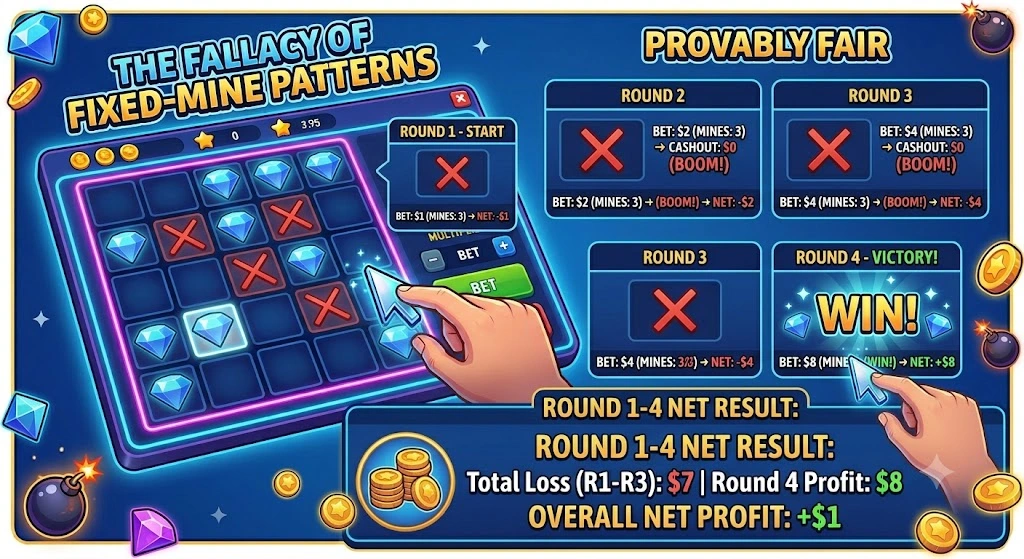
The Structural Hazard of Martingale While the Martingale approach can produce long streaks of consistent, micro-profits on high-probability layouts, it features a catastrophic downside. Due to exponential scaling, a consecutive sequence of 7 or 8 losses will completely deplete your bankroll or collide with the platform’s maximum table limit. It requires deep capital reserves to survive inevitable variance streaks.
The Anti-Martingale (Paroli) System: Compounding Positive Streaks
The Anti-Martingale framework flips the logic of the standard progression by doubling wagers after a win and resetting to the base unit after a loss. This approach is designed to insulate your core bankroll from extended losing streaks while aggressively compounding profits during hot streaks.
This strategy is highly effective when paired with high-volatility configurations, such as setting 15 to 20 mines and attempting only a single click per round. A single successful click on a high-density minefield instantly returns a substantial multiplier. By re-investing that return into a second round, you can turn a minimal initial unit into an exponential payout within two steps, while capping your downside to a single unit per cycle.
The Fibonacci Sequence: Controlled Moderate Escalation
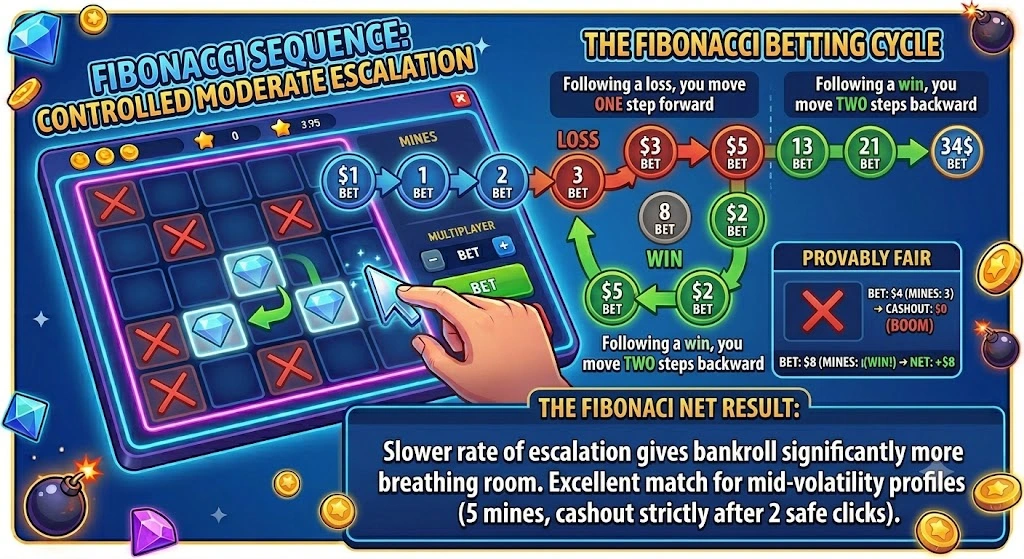
For players who find the Martingale too aggressive, the Fibonacci progression offers a less volatile alternative. Wagers are adjusted according to the mathematical sequence where each number is the sum of the two preceding ones: 1, 1, 2, 3, 5, 8, 13, 21, 34, and so on.
Following a loss, you move one step forward in the sequence. Following a win, you move two steps backward. This slower rate of escalation gives your bankroll significantly more breathing room during variance downturns, making it an excellent match for mid-volatility profiles (e.g., 5 mines, cashing out strictly after 2 safe clicks).
Advanced Bankroll Management Frameworks
The difference between a successful gaming session and a total loss always comes down to capital preservation rules. Below are two systematic frameworks designed to prevent emotional over-betting.
The Fractional Kelly Criterion Adaptation
The Kelly Criterion is a formula used to determine optimal bet sizes based on perceived edge and probability. Because the edge in casino games favors the house, a literal application of the formula would suggest betting zero. However, players can adapt a Fractional Kelly Framework to manage variance.
Instead of choosing arbitrary bet sizes, you divide your entire disposable session bankroll into a precise number of operational units. A conservative setup demands a minimum pool of 100 base units. If your total allocation is $500, your base unit (1%) is exactly $5.
Under the Fractional Kelly mindset, your maximum wager during any progression should never exceed 5% of your active session bankroll. This mathematical boundary ensures that even an unprecedented sequence of consecutive losses cannot trigger an immediate liquidation of your capital.
The Stop-Loss / Take-Profit Matrix
Before initializing the first round of the day, you must set non-negotiable financial boundaries. Emotional discipline is impossible to generate mid-session when dopamine and adrenaline are high; it must be hardcoded into your plan beforehand.
| Operational Metric | Conservative Strategy | Aggressive Strategy |
| Initial Allocation | 100 Base Units | 40 Base Units |
| Mine Configuration | 1 to 2 Mines | 10 to 15 Mines |
| Target Clicks | 2 to 3 Safe Tiles | 1 to 2 Safe Tiles |
| Take-Profit Threshold | +20% of Total Bankroll | +50% of Total Bankroll |
| Stop-Loss Cutoff | -15% of Total Bankroll | -30% of Total Bankroll |
Once your session balance crosses either the Take-Profit or Stop-Loss threshold, the execution phase ends immediately. You close the user interface, reset the cryptographic seeds, and step away from the device.
The Strategic Grid Matrix (Volatility Alignment)
To visualize how these systems interact, review the structural options available on the modern interface:
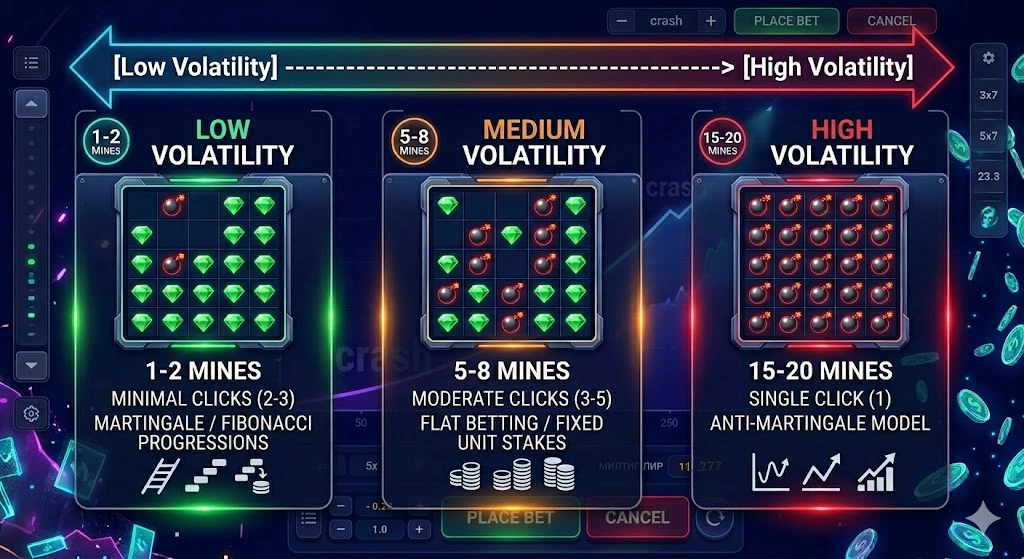
By aligning your progression choice with the corresponding mine density, you ensure that you aren’t fighting the mathematical reality of the game. High mine counts demand short, aggressive exposure, while low mine counts allow for systematic, multi-step recovery systems.
Conclusion: Systematic Play Over Impulse
The ultimate winning strategy in Mines is realizing that the grid is a fluid mathematical field rather than a visual guessing game. By moving away from random fixed-mine patterns and adopting strict progression rules, structured unit limits, and definitive profit boundaries, you tilt the behavioral playing field back in your favor. You cannot change the house edge, but with flawless bankroll execution, you can systematically capitalize on positive variance swings and protect your capital when the mines run hot.
Mines Betting Strategies FAQ