



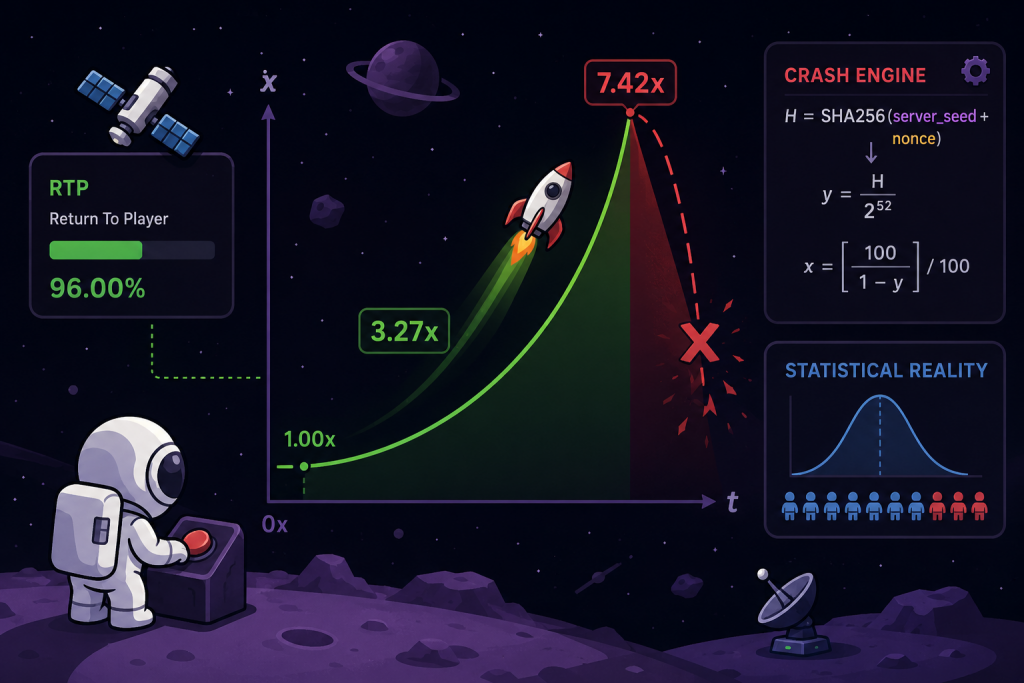
To the untrained eye, a crash game looks like a test of nerves—a psychological battle between you and a rising multiplier. But beneath the flashing animations of a taking-off plane or an astronaut drifting into deep space lies a rigid, unyielding mathematical framework.
If you want to move past casual play and protect your bankroll over thousands of rounds, you have to stop treating the game like a streak of luck. You need to understand the cryptographic formulas and statistical realities that dictate exactly when the curve collapses.
Decoding the 96.5% RTP: The Long-Term Horizon
When an official crash game software provider states that a game features a 96.5% RTP (Return to Player), it is expressing a mathematical limit.
Many players misinterpret this metric, assuming that if they start a session with $100, they are guaranteed to walk away with $96.50 after a few flights. This is a critical misunderstanding of how casino software operates.
The Law of Large Numbers
The 96.5% return rate is calculated across millions of simulated rounds, not a single afternoon session.
- Short-Term Volatility: In the span of 50 or 100 rounds, variance rules the board. You might encounter an extraordinary cluster of 10x+ multipliers, driving your personal return well over 150%. Conversely, you could hit a “cold wall” of instant crashes that drains your wallet.
- Long-Term Convergence: As your total round count scales into the thousands, the statistical reality takes over. The house edge (3.5%) acts like a gravity well, steadily pulling the aggregate payout toward that baseline 96.5% mark.
The Integrity Factor: To ensure you are actually playing on an engine tuned to its maximum theoretical payout, you must avoid unregulated, copycat scripts. Verified platforms hosting official releases with unthrottled, maximum RTP configurations are tracked and updated daily at Jetx.casino.
Inside the Engine: How Crash Points Are Calculated
Modern crash games do not rely on a simple Random Number Generator (RNG) running on a hidden corporate server. Instead, leading developers utilize a transparent, decentralized cryptographic protocol known as Provably Fair.

Before a round begins, the game engine combines two primary components:
- The Server Seed: A random 64-character string generated by the platform.
- The Client Seeds: Public strings provided by the web browsers of the first few players who placed wagers for that specific round.
The server merges these strings and processes them through a SHA-512 cryptographic hashing algorithm. The resulting complex hexadecimal string is completely unalterable and determined before the round even starts.
The Mathematical Formula
To transform a random hash into a usable in-game multiplier, the engine applies a specific algorithmic filter. While minor code variations exist between titles like Spaceman, Aviator, JetX, and Lucky Jet, the underlying algebraic logic mirrors this structure:
Where E represents a value derived directly from the hexadecimal hash.
If the random outcome falls into the house’s built-in margin space (typically the lowest fraction of the hash distribution), the engine forces an instant crash at 1.00x. This immediate absolute zero is the mathematical mechanism that secures the platform’s house edge, liquidating all active wagers before a human player or automated cashout script can react.
Probability vs. Multiplier: The Disappearing Odds
A common psychological trap in crash games is the belief that high multipliers are just as likely to occur as low ones if the game goes on a “hot streak.” The math proves otherwise. Because the crash distribution curve is exponential, your probability of survival plummets drastically the higher you attempt to ride the flight.
| Target Multiplier | Approximate Win Probability | Risk Profile | Long-Term Impact |
| 1.10x | ~87.7% | Conservative | High success rate, but a single 1.00x crash wipes out 10 wins. |
| 1.50x | ~64.3% | Moderate | Balanced threshold for baseline accumulation. |
| 2.00x | ~48.2% | Even-Money | A true coin-flip scenario once the house margin is factored in. |
| 5.00x | ~19.3% | Aggressive | Requires a deep bankroll buffer to withstand long losing streaks. |
| 10.00x | ~9.6% | Extreme | High-variance target; statistically occurs roughly once every 10-11 rounds. |
Every step up the multiplier ladder requires a massive sacrifice in mathematical probability. If you are constructing a sustainable strategy, you cannot treat a 5.00x target with the same stake configuration you use for a 1.30x target.
What This Means for Your Long-Term Success
Understanding the mathematical architecture of a crash game completely changes how you look at the interface. To protect your capital over a long horizon, implement these three math-backed rules:
- Accept the Isolation of Seeds: Because each round’s crash point is generated by an isolated cryptographic hash sequence, past outcomes have zero impact on future results. A string of ten low crashes does not increase the mathematical probability of a 100x multiplier on the eleventh flight.
- Account for the 1.00x Floor: Since the house edge is enforced via instant 1.00x crashes, any strategy that relies on incredibly high stakes to chase tiny returns (like a 1.05x cashout) will eventually get caught by an un-skippable zero. Ensure your base unit size can absorb these hard floors.
- Study Title-Specific Variations: While the overarching probability theory applies across the board, games tweak their mechanics. If you want to see exactly how these mathematical principles alter across different gaming engines, explore the dedicated Crash Game Strategies database on Jetx.casino. They break down the specific math models for major variations like:
Cryptography & Probability Mechanics