



In modern online wagering interfaces, few games match the clean mathematical elegance of digital Plinko. While traditional slot machines hide their core operations behind complex proprietary math models and rapid virtual reels, Plinko lays its structural physics completely bare. The game converts classic probability theory into a highly visual, interactive, and customizable digital engine.
To truly understand Plinko, you must stop treating it as a game of random, visual luck and start viewing it as an adjustable mathematical matrix. By mastering the core components—the physical function of the pins, the scaling architecture of the rows, and the statistical engineering of risk levels—players can systematically customize the game’s volatility to fit their precise bankroll requirements.

The Anatomy of the Drop: Pins, Rows, and Balls
The operational field of Plinko is built upon three simple, interconnected components that combine to execute a complex series of probability calculations every time the drop button is pressed.
The Pins (The Deflection Network)
The pins—also referred to as pegs—are the metallic geometric obstacles arranged in a rigid triangular grid. The function of these pins is to act as a physical binary decision point for the falling ball.
When a ball hits a pin dead center, it cannot stop or balance on it. The laws of the game’s engine force a binary outcome: the ball must deflect either to the left or to the right. In a standard, non-biased Plinko layout, the probability of either direction is perfectly split down the middle (p = 0.5). Every individual pin is a physical manifestation of a coin toss.

The Rows (The Depth Multiplier)
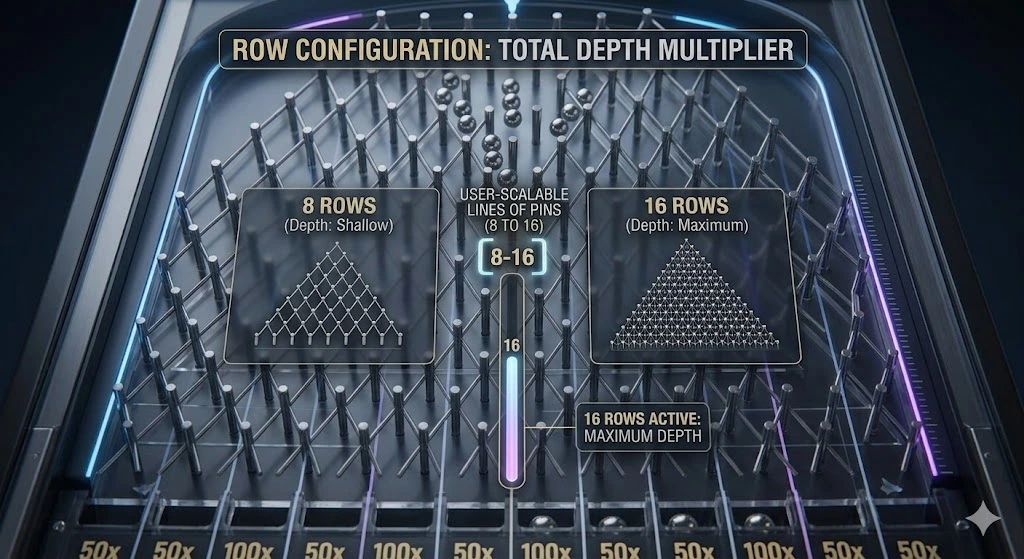
The row configuration determines the absolute depth of the triangular peg matrix. Most advanced crypto-casino engines allow players to manually scale this parameter, typically offering a selection ranging from 8 to 16 lines of pins.
The number of rows you select directly determines two vital metrics:
- The total number of operational pins the ball must collide with during its descent.
- The total number of payout pockets available at the baseline destination matrix.
The relationship between rows (R) and payout pockets (P) is absolute and linear: the number of pockets is always equal to the number of rows plus one (P = R + 1). Therefore, an 8-row configuration features exactly 9 landing pockets, while a 16-row setup expands the base to 17 landing pockets.
The Balls (The Path Trajectory)
The ball represents your active wager traversing the grid. In digital environments, the physical weight, gravity, and micro-friction of a plastic or metal sphere are accurately simulated using a cryptographic Random Number Generator (RNG) combined with a physics-based visual script.
As the ball drops from the centralized launcher, it encounters its first pin and splits its trajectory. This process repeats sequentially at every lower row. If you configure a 14-row board, the ball undergoes exactly 14 consecutive binary directional choices before settling into its final payout pocket.

The Math Behind the Pyramid: Binomial Distribution
The distribution of payouts across the bottom pockets is not random; it is bound by the laws of binomial distribution and the central limit theorem. Because a ball has an equal chance of bouncing left or right at every pin, the paths to the bottom naturally form a pattern identical to Pascal’s Triangle.
To find the number of unique paths a ball can take to land in a specific pocket, the engine uses the combinatorial combination formula:
Where n represents the total number of pin rows, and k represents the exact number of times the ball deflected to the right.
The Central Path Bias
Let us analyze a simplified 8-row board (yielding 9 destination pockets indexed from 0 to 8).
- To land in the absolute leftmost pocket (Index 0), the ball must deflect left at every single pin it encounters. There is only 1 unique path that can achieve this outcome: .
- To land in the absolute rightmost pocket (Index 8), the ball must bounce right at every single pin. There is only 1 unique path: .
- To land in the absolute center pocket (Index 4), the ball must balance its pathing perfectly, deflecting right exactly 4 times and left exactly 4 times. The number of unique paths that lead to this central pocket jumps to .

Because the total number of possible paths across an 8-row grid is , the mathematical probability of a single ball hitting the center pocket is . Conversely, the probability of hitting an extreme outer edge pocket is a tiny .
This stark mathematical contrast explains why the outer edges are loaded with massive prize multipliers, while the center pockets regularly return a fraction of your base bet. The casino doesn’t manually pull the ball away from the high multipliers; pure combinatorial math handles the defense of the board’s edges.
Risk Levels: Tuning the Volatility Matrix
While the geometric probability of path selection stays constant, modern digital versions allow players to alter the financial rewards of those paths using Risk Levels. By selecting between Low, Medium, and High Risk, you change the payout values assigned to the pockets, shifting the overall volatility profile of your session.

Low Risk: The Capital Preservation Model
In Low Risk mode, the game engine prioritizes low variance and steady bankroll preservation. The payout matrix is configured to minimize the financial penalty of landing in the highly probable central pockets.
- Center Pocket Behavior: Instead of returning zero, central pockets typically pay back around 0.5x to 0.7x of your initial wager. This means your losses are cushioned.
- Edge Pocket Behavior: Because the center is kept stable, the outer edge multipliers are heavily capped, rarely exceeding 10x to 16x your bet.
- Best Suited For: Players running linear betting progressions, high-volume wagering strategies, or clearing platform turnover requirements with minimal risk exposure.
Medium Risk: Balanced Equilibrium
Medium Risk serves as the structural baseline for standard mathematical models. It offers a balanced compromise between defensive capital preservation and high-payout potential.
- Center Pocket Behavior: Central returns drop slightly, hovering around 0.4x or 0.3x your wager.
- Edge Pocket Behavior: The value taken out of the center is moved to the wings, raising maximum payouts into the 30x to 100x territory depending on your chosen row count.
High Risk: The Maximum Variance Pursuit
High Risk mode is designed for players seeking maximum volatility. It completely alters the financial landscape of the board by crushing the center pockets to maximize the value of the outer edges.
- Center Pocket Behavior: The central pockets are turned into dead zones, paying out a tiny fraction like 0.2x your stake. Landing in the middle functions as an immediate, heavy loss.
- Edge Pocket Behavior: To offset the dead center, the rare outer edge pockets spike exponentially. On a 16-row High Risk matrix, the far pockets can award massive multipliers like 1000x your initial bet.
- Best Suited For: Players utilizing a venture-capital mindset, hunting for rare, high-magnitude payouts while accepting extended sequences of immediate micro-losses.
The Interlocking Matrix: Rows and Risk Interaction
To visualize how your configuration choices directly shape your odds, review this operational structural matrix. It illustrates how the combination of risk profiles and row depth completely dictates the volatility of your drops:
| Row Setting | Selected Risk | Central Pocket Return | Extreme Edge Payout | Session Volatility Profile |
| 8 Rows | Low | 0.7x | 5.6x | Ultra-Low (Flat, steady grind) |
| 8 Rows | High | 0.2x | 29x | Medium-High (Capped volatility) |
| 16 Rows | Low | 0.5x | 16x | Low-Medium (Deep grid, safe edges) |
| 16 Rows | High | 0.2x | 1000x | Extreme Volatility (High-stakes variance) |
Conclusion: Engineering Your Session
The true power of modern Plinko lies in its absolute mathematical transparency. By adjusting the rows, you choose the scale of your binomial distribution pyramid. By toggling the risk level, you decide how heavily you want to penalize central outcomes in exchange for compounding edge rewards.
Mastering Plinko requires aligning these two parameters with your active bankroll limits. Stop guessing where the ball will fall, accept the geometric reality of the grid, and configure the matrix to match your risk tolerance perfectly.
Plinko Risk & Volatility FAQ