



The sight of an object bouncing through a field of geometric obstacles, losing control with every deflection before landing in a high-stakes pocket, is one of the most recognizable sights in gaming. Today, millions of active players interact with this mechanical concept on blockchain interfaces, setting rows, selecting risk tiers, and letting digital chips drop at lightning speeds.
Yet, long before the first cryptocurrency ledger was mined, this exact system was captivating millions of daytime television viewers. The history of Plinko is a narrative of mechanical genius, behavioral psychology, and mathematical inevitability. It is the story of how an analog television gimmick designed to teach pricing psychology evolved into a foundational pillar of the modern iGaming industry.

The Analog Birth: Frank Wayne and The Price Is Right
To find the true origin of Plinko, we must travel back to the early 1980s inside the walls of CBS Television City in Hollywood. The executive producer of the iconic game show The Price Is Right, Frank Wayne, was searching for a new “pricing game” that could anchor the show’s rotation. Wayne wanted something that combined raw visual suspense, an unmistakable auditory signature, and a completely transparent mechanic that required no skill from the contestant.
On January 3, 1983, host Bob Barker introduced television audiences to Plinko for the first time. The rules were simple: contestants earned round plastic discs (called “chips”) by correctly guessing the retail prices of consumer products. They then climbed a staircase to a platform overlooking a massive, inclined wooden board covered in rows of metallic pegs.

The contestant held a chip over the board, chose a starting position, and released it. As the disc fell, it collided with the staggered pegs, producing a distinct “plink-plink-plink” sound as it deflected left and right before sliding into one of nine cash pockets at the bottom. The central pocket held the ultimate grand prize, flanked by lower values and zero-dollar traps.
The game became an overnight cultural phenomenon. The mechanical uncertainty of the physical chip created an unmatched television viewing experience. Contestants would scream at the board, leaning sideways as if their body movements could influence the microscopic friction of a plastic disc against a metallic peg. Frank Wayne had unlocked a core truth of human psychology: the illusion of control within an environment of absolute randomness.
The Unintentional Science: Sir Francis Galton’s Quincunx
While Frank Wayne popularized the game on television, he did not invent the underlying math. The structural layout of the Plinko board is a direct adaptation of the Galton Board, also known as the quincunx, invented by the Victorian polymath Sir Francis Galton in 1873.
Galton designed his board to visually demonstrate the Central Limit Theorem and the principles of normal distribution. In a perfect quincunx board, a dropped ball encounters a symmetrical grid of pegs. At every single peg, the ball has an equal probability (p = 0.5) of deflecting to the left or to the right.
The Binomial Expansion
As a ball travels down through a series of rows (n), the path it takes can be mapped directly using binomial coefficients, which are beautifully organized in Pascal’s Triangle:
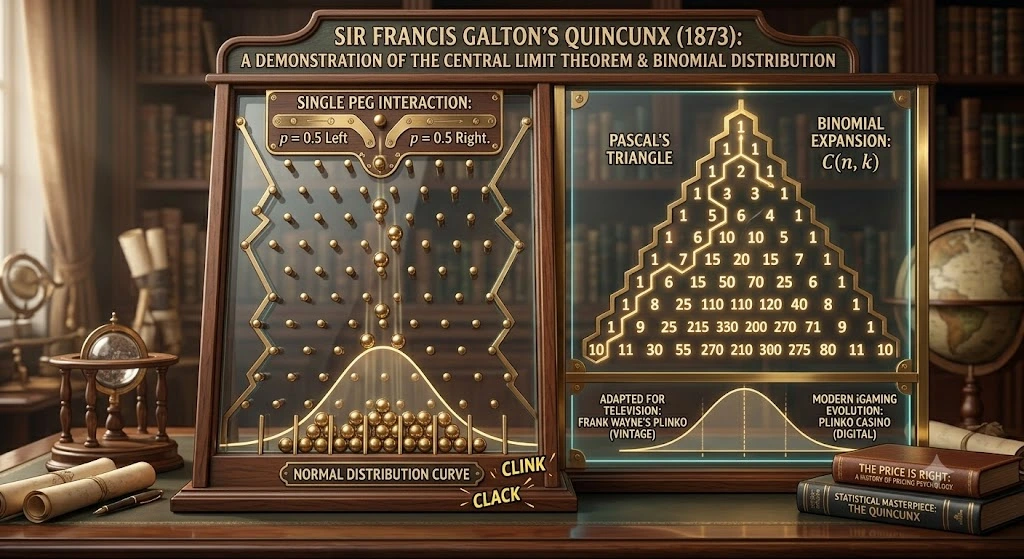
The total number of unique paths to reach a specific pocket at the bottom of an $n$-row board is given by the binomial coefficient:
Where n is the total number of rows of pegs, and k is the number of right-sided deflections the ball experiences. Consequently, the probability of a ball landing in a specific pocket follows a strict binomial distribution.
Because there are far more paths leading to the central pockets than to the extreme outer edges, the accumulation of dropped chips over time will inevitably construct a perfect Gaussian bell curve. Frank Wayne utilized this mathematical certainty to protect the show’s production budget: he placed the highest cash rewards directly in the center where chips were statistically most likely to land, while placing lower values at the outer edges where paths were mathematically rare.
The Digital Transformation: Casual Gaming and Video Games

As television entered the late 1990s and 2000s, Plinko’s cultural footprint expanded beyond broadcast networks. The game show mechanic began leaking into the broader video game industry, serving as a template for arcade systems, mobile apps, and casual digital puzzles.
The most notable mainstream adaptation of the peg-deflection mechanic arrived in 2007 with PopCap Games’ hit title, Peggle. While Peggle introduced active aiming, colored pegs, and cinematic power-ups, its primary emotional hook relied on the exact same tension that fueled Frank Wayne’s 1983 invention: watching a spherical object bounce unpredictably through a digital grid while anticipating a high-value landing.
During this era, online arcade platforms and flash gaming portals flooded the web with rudimentary Plinko clones. However, these early digital iterations lacked a crucial component. Because they operated on standard closed-source random number generators (RNGs) without financial stakes, they remained simple novelty simulations. The true evolutionary leap required a shift in technology that could merge financial risk with mathematical transparency.
The Crypto Renaissance: Volatility, Customization, and Provably Fair
The modern era of Plinko began around 2019 within the emergent landscape of cryptocurrency iGaming. Pioneered by innovative software developers like Spribe and native casino studios such as Stake Originals, Plinko was stripped of its colorful, slow television set dressings. It was re-engineered into a clean, minimalist, high-frequency digital trading interface.
Crypto developers realized that the classical Galton Board model was uniquely suited for blockchain integration due to its modular design. In the digital environment, players are no longer bound by a physical piece of wood; they can alter the laws of physics and probability in real time through the user interface.
The Mechanics of Digital Customization
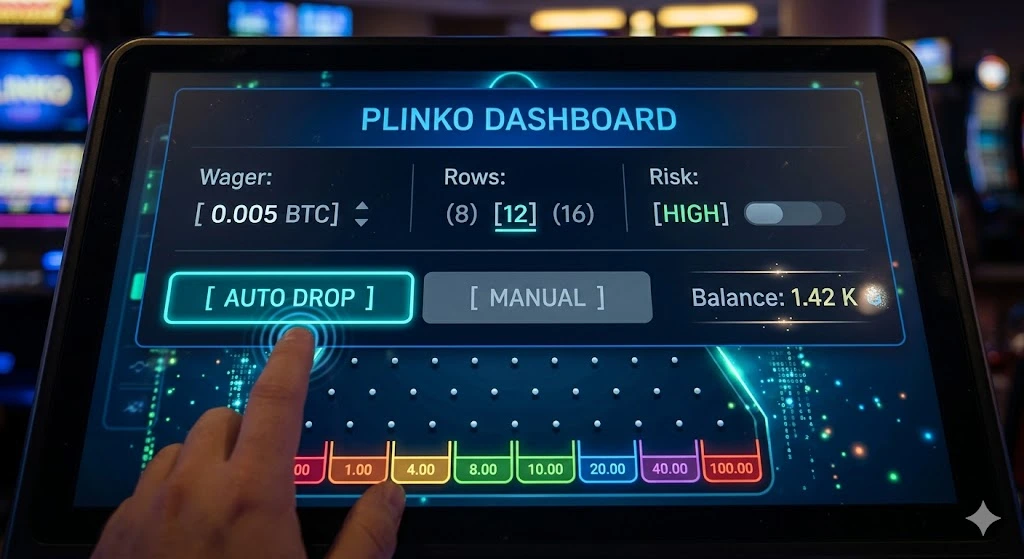
Modern crypto Plinko introduces three core variables that completely alter the volatility profile of the game:
- Row Configuration: Players can manually scale the size of the pyramid, typically choosing anywhere from 8 to 16 rows of pegs. Expanding the number of rows increases the total number of payout pockets at the base, widening the mathematical variance.
- Risk Tiers (Low, Medium, High): Instead of a fixed television payout layout, players choose their risk tier. A “High Risk” configuration flattens the center of the bell curve, dropping the middle pockets to fractionally low payouts (e.g., 0.2x your wager) while packing the rare outer edges with massive, exponential multipliers (up to 1000x or more).
- High-Frequency Execution: Unlike a television contestant who drops one chip every two minutes, a crypto player can activate automated betting modes, dropping hundreds of digital chips simultaneously. This turns the interface into a flowing, dynamic visualization of a live mathematical distribution curve.
Cryptographic Transparency: Provably Fair Plinko
The absolute turning point that solidified Plinko as a cryptocurrency staple was the introduction of Provably Fair algorithms. In traditional online casinos, players often suspected that digital ball drops were rigged by backend code designed to actively dodge high-value multipliers.
Blockchain Plinko resolves this trust deficit entirely by making the generation of every path transparently verifiable using standard cryptographic primitives (such as SHA-256 or HMAC). The specific path a digital chip takes through the peg matrix is calculated using three distinct variables:
- Server Seed: A secure random string provided by the casino platform, which is hashed and shown to the player before the round starts so it cannot be altered mid-drop.
- Client Seed: A custom string generated by the player’s web browser (or manually written by the user), ensuring the casino cannot pre-determine or control the winning outcome.
- Nonce: A sequential counter that ticks up by 1 with every consecutive bet placed during the session.
When a player hits the drop button, the software combines these three inputs into a single cryptographic string. This string is processed into a stream of hexadecimal bytes. The software reads these bytes sequentially: each byte determines whether the chip bounces left (0) or right (1) at each consecutive row of pegs.
After the bet concludes, the casino reveals the unhashed server seed. The player can paste this seed into any open-source verification script to check the math themselves, proving with absolute certainty that the digital chip followed a path dictated entirely by pure probability.
Conclusion: The Ultimate Convergence of Form and Formula
The journey of Plinko from a 1983 Hollywood television stage to the decentralized servers of modern crypto casinos is a testament to the timeless appeal of geometric probability. Frank Wayne’s brilliant television design was, in essence, an early form of user-controlled gamification. By mapping that exact analog suspense onto a customizable, provably fair digital matrix, the iGaming industry did not replace Plinko—it simply fulfilled its true mathematical destiny. Plinko remains an iconic blend of simple design and complex math, proving that whether the chip is made of physical plastic or cryptographic code, the thrill of the bounce remains completely universal.
Plinko History & Mechanics FAQ